Meeting at Night
Sea, beach, moon, fields, a tap at the pane and two hearts: Browning completes an entire night journey in a very short poem. Its love is carried not by declaration but by someone actually crossing distance to arrive at another light.
Verbs turn a short poem into a film
Nearly every stage of Meeting at Night is movement: the boat approaches the cove, its prow reaches sand, a figure crosses warm beach and fields, then taps softly at a pane. Browning explains neither the relationship nor what follows the meeting. The reader therefore inhabits the approach itself. The poem’s cinematic quality comes less from decorative description than from distance repeatedly crossed by a body.
Let the rhythm become a heartbeat in the dark
The complete master is now verified. Acoustic guitar, soft accordion, warm strings, a long graceful opening and Bollywood Male's cinematic arc build the night crossing, while the source also names Portuguese fado colour. No rap, EDM or harsh drums, plus an instruction against sudden octave jumps, keep the melody smooth and singable. The climax does not become a mass chorus; matchlight and two hearts retain the force. These are disclosed compositional influences, not claims to represent living Indian or Portuguese traditions.
Darkness must still contain direction
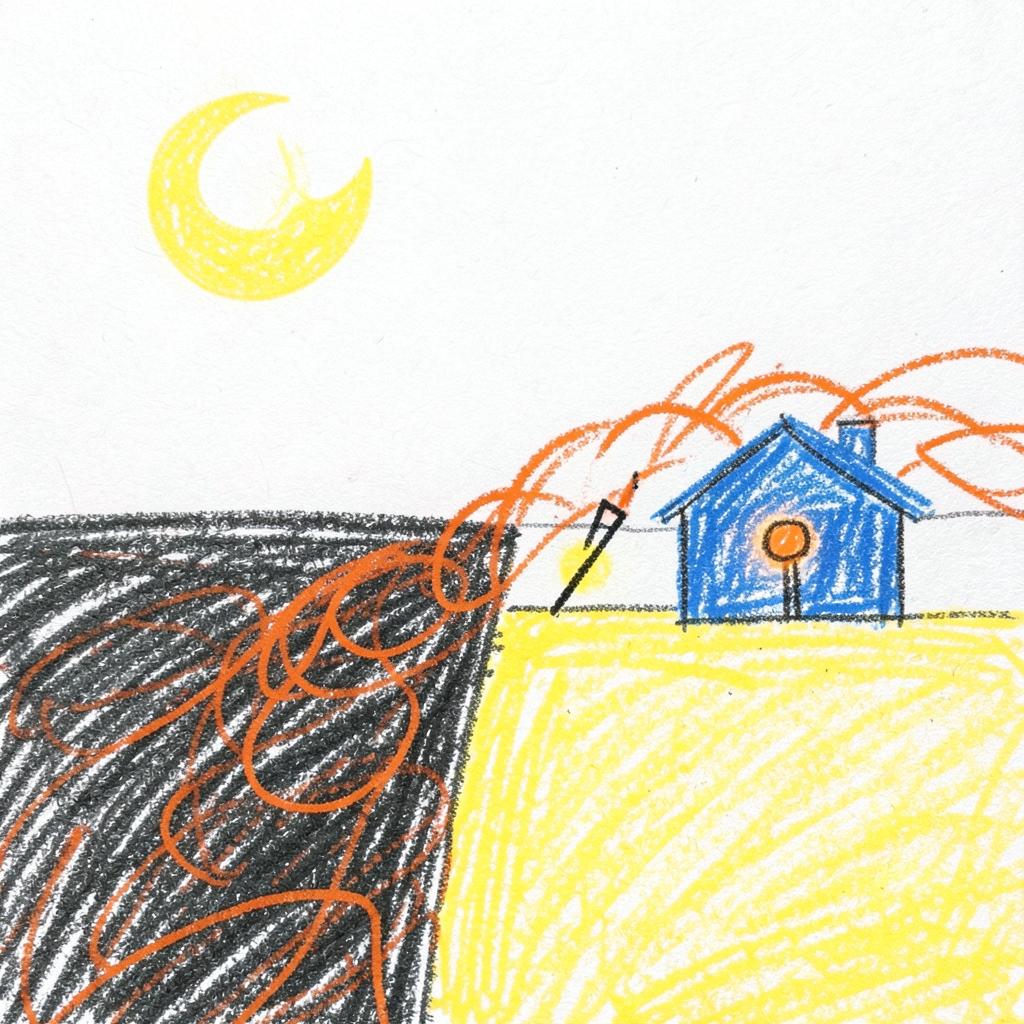
The source film does not disguise the earlier storyboard proposal as live action. One crayon-like artwork holds the complete song: yellow crescent, black sea, sand, blue house and an orange-red path keep direction inside the rounded card while captions move through stanza one, stanza two, bridge, final refrain and outro. Eight checks from 10 to 220 seconds confirm that the film reaches two hearts in silence meet. The platform breaks lighted into light / ed and leaves a period alone. Those source marks remain; the style is not called a real child's work, and the coast, farmhouse or lovers are not presented as filmed places or people.
The most shareable action of love is the journey toward someone
Cultures differ in coastlines, windows and conventions of meeting, but the knowledge that someone crossed the night for you needs little translation. An English setting can stay close to the poem’s swift sequence of shots. A Chinese re-imagining may make the journey more conversational—‘I came to see you’—while preserving the quiet before the tap. The route from cold sea to two beating hearts is more memorable than any exaggerated promotional title.
Songs in this story (1)
One after another, back to the top at the end — until you stop it. Tap any song to carry on from there.
- 1Meeting at NightGrey sea, long black land, a low half-moon and little waves leaping in fiery rinMV