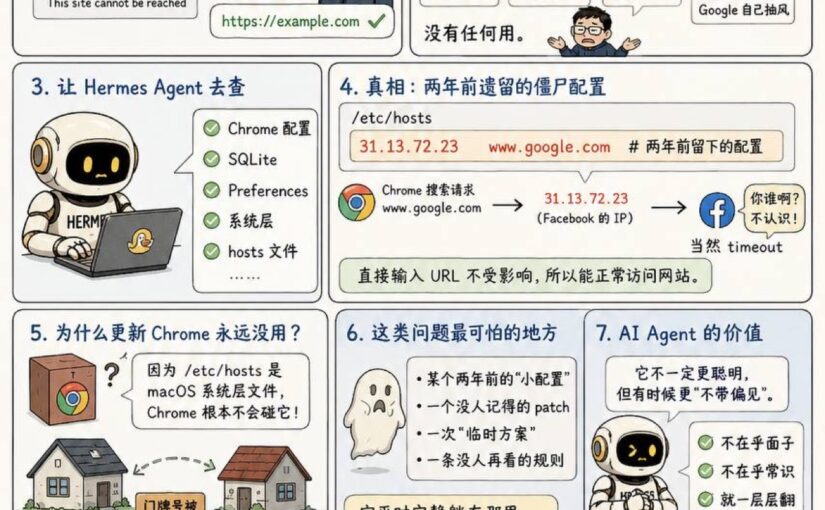

Something very "AI era" happened today.
My Chrome had been broken for two years.
The symptom was bizarre: Type a keyword in the address bar, Google Search would spin forever. Later it started saying "this site cannot be reached." But typing a URL directly? That worked fine.
For two years, I did every standard thing an IT person would do:
Reinstall Chrome. Upgrade Chrome. Delete Profile. Check extensions. Check DNS. Check proxy settings. Check search engine config. Even suspected Google itself was glitching.
Nothing helped.
Then today, I asked my Hermes agent Tuya to look into it.
Tuya didn't stop at the FAQ-level "try reinstalling." It started digging like a battle-hardened sysadmin, layer by layer:
Chrome configuration. SQLite database. Preferences. System layer. hosts file.
And finally unearthed this:
A two-year-old zombie config sitting in my /etc/hosts:
31.13.72.23 www.google.com
That IP? It belongs to Facebook.
Which means:
For two whole years, every time I typed a search query in Chrome's address bar, I was essentially saying:
"Take my Google request and hand it to Facebook."
Facebook, of course, was baffled: "Who the hell are you?"
And timed out.
The truly absurd part?
Updating Chrome could never fix this. Because /etc/hosts is a macOS system file. Chrome never touches it.
It's like:
Someone secretly changed your house number to your neighbor's address, and you kept ordering furniture that could never find its way home.
But here's the deeper thing:
The scariest part of this kind of problem isn't complexity.
It's that you'd never think to look there.
Normal people check the browser. Check extensions. Check the network. Check DNS.
Who would think: "Chrome won't search" has anything to do with a Facebook IP hidden in /etc/hosts?
A lot of real-world problems work exactly like this.
What really tortures you isn't the "major outage."
It's some tiny config someone left behind two years ago. A patch nobody remembers. A "temporary fix." A rule nobody reads anymore.
It lies there quietly, like a corpse.
Until one day, the whole system starts slowly poisoning itself.
And everyone keeps debugging on the wrong layer.
This is actually what makes AI agents interesting.
They're not necessarily smarter than humans.
But sometimes they're less biased.
Human experience can be so strong it becomes a cage.
"Chrome broken" → must be Chrome. "Network issue" → must check DNS. "Search not working" → must reinstall the browser.
But an agent doesn't care about saving face. Doesn't care about industry common sense.
It just digs down, layer by layer.
And sometimes, it digs up a corpse.
Two-year zombie config. Laid to rest today.
