When most people first hear the word "token," their instinct is:
This must be some mysterious thing inside AI.
It's not.
Token isn't mysterious at all.
It's almost mundane.
At its core, a token is simply:
"a data unit after segmentation."
Humans see a sentence and feel it's a naturally whole.
For example:
"The weather is nice today."
But to a large language model, this isn't a complete object — it's a pile of fragmentable data chunks.
It might get split into:
"The / weather / is / nice / today"
Or even finer pieces.
Same with other languages.
Same with images, audio, video, even actions.
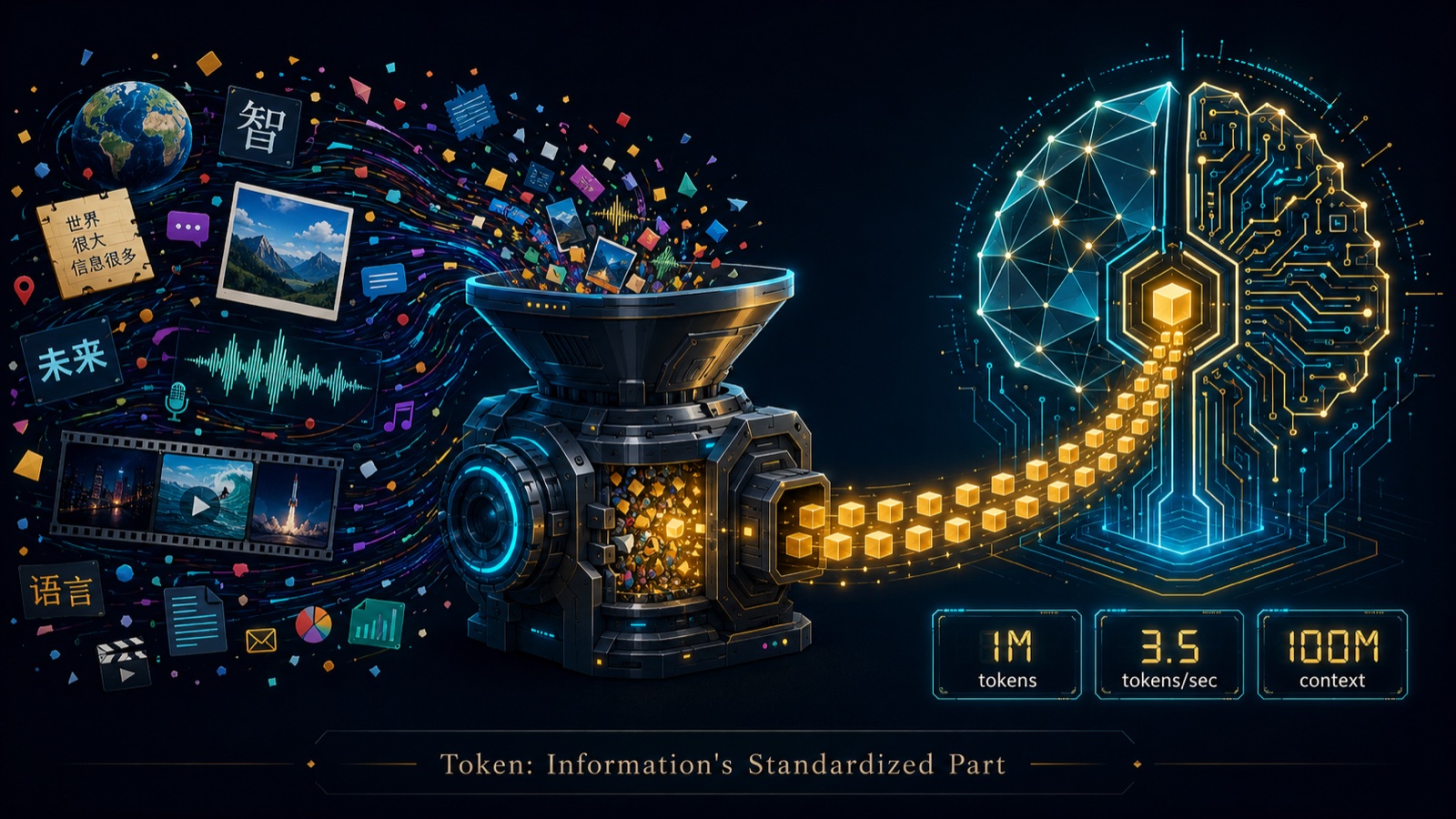
A picture gets chopped into pixel patches. A sound gets sliced into audio fragments. A video gets cut into consecutive frame pieces.
Because when AI sets out to process the world, its first step isn't "thinking the whole"
It's:
Smashing the world into pieces first.
Why must it smash?
Because only after smashing can you count. Only after counting can you find patterns. Only after finding patterns can you analyze and think, or train models to do the same. Only after training models does what we call "intelligence" emerge.
It's a lot like the Industrial Revolution.
A raw iron ore can't directly become a car.
It must first be crushed, smelted, standardized.
Data is the same.
Only when cut into standard units can data enter the modern AI industrial system.
And so, the token was born.
Token isn't mysterious.
It's simply:
"information's standardized atomic part after industrialization."
And once the world is tokenized, many things suddenly shift.
Because:
It becomes countable.
Before, humans had no precise way to measure "intelligence consumption."
But with tokens, AI gains something akin to:
"kilowatt-hours of electricity" "tons of oil" "network bandwidth"
A unit of measure.
It's not perfect.
But it's enough to kick the entire token industry into industrial-scale operation.
So today's entire AI world orbits around tokens.
Training models consumes massive tokens.
ChatGPT and DeepSeek "eat" countless tokens every day.
A user's question? Input tokens.
An AI's answer? Output tokens.
Context windows keep growing, token consumption keeps climbing.
Today's leading models accept millions of tokens of context.
What does that mean?
It means you can dump an entire GitHub repo, a 200,000-word document, a thick book, all into the model's context in one shot.
And here's the more interesting part:
Before, humans were talking to AI.
Now, Agents consume tokens on their own.
They decompose tasks themselves, call tools themselves, write code themselves, test themselves, roll back themselves, re-plan themselves.
Tokens start burning in an internal machine loop.
This is like after the Industrial Revolution, when coal stopped being just for home heating and began driving the entire industrial system.
Many people still think:
AI is just a chatbot.
But taking the longer view,
The world might be entering a new industrial era:
Electricity powers chips, chips produce tokens, tokens organize intelligence, intelligence remakes the world.
The internet era flowed with bits.
The AI era, might just flow with tokens.
And whoever can produce high-quality tokens at the lowest cost, at the largest scale, with continuous stability —
may occupy the high ground of the next-generation digital economy.
This industrial revolution of tokens has only just begun.