Morning Glory and Afternoon Collection — Ch.1-2: A Brief Biography of Li Wei
by Li Wei (立委)
Life is short — trim off the beginning and the end, and you're left with perhaps thirty to fifty years. These can be divided into three stages: the career-building years (one's thirties), the mature years (one's forties), and the declining years (one's fifties and beyond). In Chinese custom, these stages are reflected in how one is addressed: Little Li (Xiao Li), Big Li (Da Li), and Old Li (Lao Li). But alas, I, Li Wei, leaped straight from Little Li to Old Li, never having the chance to savor the grandeur of my prime — a fact that has always left a faint ache in my heart.
Having skipped two grades between kindergarten and elementary school, I was always the youngest in my class. Born in the notorious hunger year besides, I was frail and undersized, often excused from PE with a doctor's note or sent home altogether — perpetually the little runt. Fortunately, as middle school began, a "revisionist resurgence" was underway: Mao had tasked Deng XP with cleaning up the Cultural Revolution's wreckage, and Deng in turn charged Zhou Rongxin, the education czar, with restoring order to the schools. The campus climate was renewed. Riding this tailwind, I began to distinguish myself. As class academic officer and math subject representative, I was assigned by the classroom tutoring teacher to mount the podium every morning during self-study period to demonstrate problem-solving strategies — practically a teaching assistant. But fair weather never lasts. The Gang of Four slandered Deng and calculated against him, and the Revolution faction regained the upper hand. The school descended into chaos. Academic classes were pushed to the background; "mass criticism" sessions became the main curriculum, supplemented with learning from workers, peasants, and soldiers on site. Unable to shine through academic subjects, I nevertheless lost no ground — in fact, my prominence only grew. For I was the master of polemical writing, having moved through the successive campaigns: Criticize Lin Biao, Criticize Confucius, Criticize Deng, Counter the Right-Deviationist Wind in education, and finally, Criticize the Gang of Four. At every assembly, large or small, whenever I spoke, my voice rose and fell with cadence and force, punctuated by wit and humor. I became a sensation on campus, celebrated far and wide. Some said I carried the legacy of Lu Xun — penetrating to the bone, yet always bringing forth the new from the old, a cascade of apt phrases. At open-air gatherings of a thousand people, the crowd was typically restless and disorderly, but the moment I stepped onto the platform, complete silence fell. They listened with rapt attention, and when I reached a punchline, laughter rippled through the audience. From this I forged a reckless courage and an immunity to stage fright — a gift that has served me all my life.
By the time I reached university — the prestigious Class of '77, the first cohort after the Cultural Revolution — I was still at the tail end, with classmates older than me by anywhere from one to over ten years. Among classmates we all called each other by name, except for my desk-mate, the youngest of the "Seven Fairies," who teasingly called me "Little Li Wei." It wasn't out of affection but rather to avoid suspicion — to demarcate clear boundaries. For four years we shared a desk, yet kept strictly apart — a Chu-Han divide, a clear line between Jing and Wei. The Seventh Fairy, naturally clever, used the pretext of being one year my senior to call me "Little Li Wei," thereby making our interactions, such as they were, officially above reproach.
Once the Seventh Fairy set this unfortunate precedent, the "Little" epithet stayed with me for years. Teaching middle school, I was called "Little Teacher Li" (age 22). In graduate school, I shuffled in and out of the computer lab, disheveled and unkempt, muttering to myself in "the world's language" (Esperanto), eventually becoming a campus joke (ages 23–26).
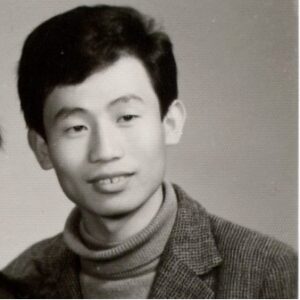
Caption: Full of youthful vigor and high spirits (1987).
After graduating from the Chinese Academy of Social Sciences and staying on at the institute, tales of Li Wei continued to circulate — mostly stories of love at first sight, a lightning marriage, chronic dishevelment, and the time I walked into a wall and had to apologize for it.
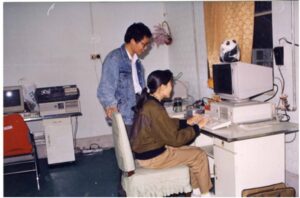
Caption: Li Wei directing machine translation system development at a Zhongguancun company (1988).
Thus I dug in at the research institute and the Zhongguancun company for five years (ages 26–31), honing skills akin to those of an old traditional Chinese doctor. My specialty was treating computers, taming their language functions. During this period, the fever for going abroad kept rising, spreading from Shanghai to Beijing. On every street corner, conversations inevitably turned to America, Japan, Britain, and Australia. Yet Li Wei and his "immediate superior" (my wife) ambled along in blissful ignorance, wrapped up in each other — like the old saying, "unaware of the Han dynasty, let alone the Wei and Jin". Not until every last classmate had departed did Little Li suddenly wake up. With grim resolve, he took the TOEFL exam and scrambled for the last train. As it happened, the Y.K. Pao Foundation was selecting promising talents, and through sheer luck, Little Li was chosen and dispatched to the Chengdu University of Science and Technology's overseas training center for half a year of preparation.
Who could have guessed that this would become the watershed between Little Li and Old Li. The talents gathered at the training center — men and women alike — were the best from every region and every field, divided into two groups: the one-year visiting scholars, mostly older, and the three-year doctoral scholarship recipients, mostly young rising stars. Li Wei, in the latter group, now found himself the senior. Every time there was an exam, Wei inevitably took top honors, drawing a stream of talented men and women to his door with questions large and small. The sound of "Old Li" never ceased. Li Wei became a minor celebrity for a time, with a devoted following.
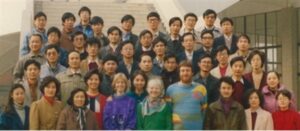
Caption: The talented men and women of the Chengdu University of Science and Technology Overseas Training Center (1990).
In the blink of an eye, Little Li had transformed into Old Li, basking in widespread esteem. As a foreign-language major, I should have been exempt from the English test. But the authorities, making no distinction, rounded everyone up and shipped us all to Chengdu, the "Land of Abundance" for centralized feeding. It wasn't just English — there were also policy training sessions. All my brothers and sisters worked conscientiously, scrambling to get ahead. Only Li Wei took it easy, spending his days indulging in Sichuan cuisine and lingering in teahouses and bars, much to the envy of his peers.
Though the title "Old Li" was coined in Chengdu, in my heart I didn't fully accept it. At that time my career was flourishing, at high noon — wide networks within the field and beyond. My associations were all with learned scholars; no common folk crossed my threshold. My advisor was a titan of the discipline, and I was his sole final protégé — his "closed-door disciple" (all the others having "betrayed" the motherland and fled to America). I was a "young" talent, a rising star, commanding the sidelong respect of my peers. On the eve of my departure from China, the national machine translation community held its annual gathering at the Fragrant Hills Guesthouse in Beijing. The highlight was a dinner conversation between my advisor and another giant of the field — what came to be known as the "Liu-Dong Dialogues" — throughout which Li Wei appeared repeatedly, furnishing his advisor with examples and explaining details. So influential was this that the assembled junior female scholars (mostly out-of-town graduate students newly entered into the field) flocked to Li Wei for guidance. Regrettably, with my mind so set on flying far away, I missed a golden opportunity to mentor these aspiring younger scholars.
After leaving the country, the years passed: from Britain to Canada, from Canada to America. Drifting and displaced, never knowing where I'd settle — my prime years flowing away like water. By the time of my eight-year tech start-up campaign in Buffalo (ages 37–45), my youth was gone, my prime had passed, and "Old Li" had become an honest name. Yet my ambition never waned. I redoubled my efforts, fighting on two fronts, and carved out a domain of my own.
Caption: Li Wei at his Buffalo office (2000).
Looking back, I can't help but sigh. My life — from youth to prime, precisely when my creative powers were at their peak and energy overflowing, with timing, place, and people all aligned — was cut in half by the long years of study abroad, everything reset to zero. Years later, after eight years of entrepreneurship, I returned to China to visit family. Amid clinking glasses at a hotel restaurant, I was enjoying a joyful reunion with family and relatives. During a brief pause in the feast, I strolled out onto the balcony to enjoy the cool air and take in the Beijing nightscape. There I happened upon an elegant young woman with a small child. Seeing my gray hair, she instructed the child: "Say hello to Grandpa." My blood pressure shot up, thunder crashed in my head, and all the wine in my belly turned to cold liquid, sliding down my spine.
Written on January 9, 2010.
朝华午拾 · 第一章之二:立委小传
立委列传
立委者,不知何许人也。少而敏,长而异,行迹颇诡于常人。
其生也,岁在荒年,形羸而志劲。未及冠,已连越学级,故恒处群中之末,年最幼焉。
然幼而不弱,虽体弗胜力,而心不屈志。
及中学之初,时局稍靖。上整学政,下肃庠序。立委因之得志,
为学官所擢,日登讲席,剖析数理,旁若无人,俨然少师。
众或异之。
未几,风复骤变。政教反覆,文艺退处,群趋口舌。
立委遂弃算而执笔,纵横批判之场。
其辞激而不燥,其论峻而多趣。
凡大会所集,千人喧沸,及立委登台,则声寂如林。
及其词锋所至,笑声震野。
或曰:“有鲁迅之遗意焉。”
由是胆气既张,临众不惧,终其身不改。
既入大学,岁在七七之年。
同学或长十余岁,呼名无忌。
惟其同席一女,独称之曰“小立委”。
非亲也,实所以避嫌而自别。
四年同案,界若河汉。
“小”字遂附其名,不可去。
其后为师,人称“小李”;
又入机房,昼夜沉思,口诵异语,众以为狂。
然其志固在远方,不为俗议所移。
及壮岁,入社科之府,留而不去。
或以情结婚,或以拙致笑,或以直触壁。
然其技益进,主译机器之文,疗电脑之疾,如良医治顽症。
五年之间,术成而名隐。
是时也,四海骚然,言出国者如市。
立委独处一隅,与其所亲者,相对忘世。
不知潮起。
及同侪尽去,乃幡然悔悟。
遂赴成都,入出国之塾。
群英毕集,才俊云合。
分为二辈:长者为学者,少者为新秀。
立委在新秀之中,忽为其长。
试辄居首,众皆仰之。
有事无事,咸趋其门。
“老李”之名,由此而生。
然立委心未以为然。
其时事业方张,师承名宿,交游尽鸿儒。
去国之际,香山论道,群贤在席。
立委数为师发言,条分缕析,众皆侧目。
后学相从者众,而其志已决,遂弃之而去。
既出国门,流转英加美三地。
岁月忽忽,若水东逝。
本当盛年,乃为学途所系。
他乡数载,非益其有,乃重其始。
人生之书,中叶忽断。
及至水牛城八年,鬓已微霜。
然志气未衰,犹能并驱两途,自立一隅。
后归故国,与亲友宴。
酒酣,独步于台。
忽遇一妇,携子而行。
见立委,命其子曰:
“呼爷爷。”
一言既出,天地俱寂。
立委怔立,若遭霆击。
酒气尽消,寒意自脊而下。
乃知——
名之所加,非虚也;
岁之所夺,不可返也。
太史曰:
人之生也,或以年序其行,或以名乱其序。
立委少而老名,壮而学子,
行不由己,时为之也。
夫所谓“老李”者,
非老于岁,乃老于世。
嗟乎!
名先于人,人生其后;
时夺其年,志存其余。
观立委一生,
非不得其时,
乃时不得其全也
From 朝华午拾 (Morning Glory and Afternoon Collection). Original Chinese: 乡愁是一张无形的网 (Nostalgia Is an Invisible Net).
