Note: From the perspective of when this was written, this was the very first piece in my Morning Glory at Noon nostalgia series — the one that started it all. Looking back, those "dragon gate" moments — the college entrance exam and the graduate school exam — were truly the pivotal turns of fate in life. When I visited home recently, both my elder brother and my senior colleague told me the same thing: the life trajectories of our generation were largely sealed at the moment we faced the dragon gate. That's deeply unfair, because so many classmates' talents and potential could never be fully measured by an exam-oriented education system. But that is how society ranks people — essentially the same imperial examination system in modern form. Opportunities and resources ultimately fell to the fortunate few who leaped through the dragon gate. It fills one with sighs.
The year I graduated, like everyone else, I took the graduate school entrance exam, applying to the English and American Literature program in the Foreign Languages Department of Nanjing University. I failed miserably. How could the education we received compare to Nanjing University's? Later, at the Chinese Academy of Social Sciences, a female classmate from Suzhou — a Nanjing University Foreign Languages graduate from the class of '77 — told me that the exam that year had been extraordinarily difficult. The number of applicants was enormous, and most people's scores were unbelievably low. My very first attempt had run into a brick wall. That year, only one person from our class passed: a Shanghai classmate, who went to the Foreign Languages Department of Anhui University.
After graduation, I was assigned to teach at Fanchang High School, a county near my hometown. Two lessons I learned there: First, I wasn't suited for teaching — especially the younger grades and the "slow classes." I simply couldn't maintain order; I had no way to handle the mischievous kids. Walking into that classroom felt like marching to the execution ground. (Teaching the honors classes or high school was better — the students respected me more, and I felt good about it.) Second, I worried constantly that over time, if I lost control, something inappropriate might develop between me and a female student. Perhaps it was biological — girls in junior high easily develop crushes on young male teachers, and if the teacher can't keep his bearings, it's easy to cross the line. Fanchang High School had a precedent, and it ended tragically: the teacher and student both jumped from a high building, and the teacher's skull was shattered.
The only way out was the graduate school exam. So I took the application handbook and flipped through it back and forth, until I discovered that the Institute of Linguistics at the Chinese Academy of Social Sciences had a program in Machine Translation with very particular requirements: two foreign languages, linguistics, advanced mathematics, discrete mathematics, politics, and a comprehensive exam. I felt this might work — I could play to my strengths and avoid my weaknesses. After all, in our era, practically no one who knew mathematics also knew two foreign languages, and it was rare for someone proficient in languages to be able to handle mathematics. I had studied advanced mathematics, but I'd never heard of discrete mathematics. I asked around — everyone had a different interpretation, and I was just as confused as before. As for what machine translation even was, that was equally mysterious. So I went to consult a teacher who taught math and science at Nanling No. 2 Middle School. This teacher was unusual — he loved to read, was broadly knowledgeable, and had his own independent opinions. He said with great confidence: "This is a good field — it's an interdisciplinary area where it's easy to make contributions. The subject itself is practical, and it has a future." His insight convinced me, and I locked in my direction.
That year, I still didn't pass — the main culprit was the "comprehensive exam." The Institute of Linguistics had borrowed the exam paper from Peking University's Chinese Department, pulling questions from every subfield: "In what year was Chairman Mao's 'Talks at the Yan'an Forum on Literature and Art' published?" and so on — thoroughly mean-spirited, with non-Chinese-major students at an obvious disadvantage. It seemed like discrete mathematics also did me in. But Beijing still sent someone to Fanchang to conduct a background investigation on me, which proved I had come close. This gave me tremendous confidence — at least I wasn't groping in the dark anymore. It also confirmed that my strategy of playing to my strengths had been right. Otherwise, in all of China, why would they have bothered investigating me after I failed? Clearly, more people had done worse than me. (Later I learned this was indeed the case — that year, not a single person met the program's threshold, which is why they recruited again the following year.)
The second year, I prepared for the battle again. The preparation was still grueling, but the goal was now crystal clear. My father borrowed a quiet little room from a neighbor for me and gave strict orders that no one was to disturb me. Beyond working through exercise book after exercise book of mathematics, for the humanities subjects I recorded myself explaining key concepts and listened to the tapes over and over, day and night. What is historical comparative linguistics? What are componential analysis and structural analysis? What is transformational-generative grammar? What is the difference between deep structure and surface structure? On and on. When I got tired of studying, I would often walk out to the fields beyond the old town wall and gaze at the endless, brilliant yellow rapeseed flowers, breathing in the fresh air. Many times I ran into my father on the road. He would say: "Good to take a walk, rest your brain a bit." His eyes were full of approval and encouragement.
The exam was to be taken at a testing center in the neighboring county. My father saw me off at the bus station. Just before I boarded, the weather began to turn cold and the wind picked up. Dad took off his woolen Zhongshan suit — his finest jacket — and draped it over my shoulders. From the bus window, I saw him waving in the cold wind. That is the image etched in my memory: the turning back at the bend in the road. At the exam center in Xuancheng County, I stayed in a shabby guesthouse. Three straight days of exams — when I came out after each session, I was utterly drained, on the verge of tears. On the evening after the exams, I went to the movie theater, and there I found a place to vent. They were showing two Chinese short films, artistically mediocre, but at least they had a touch of tragedy. And so, following the plot, I cried from beginning to end. I wept until the sky went down and the earth spun — but it felt so, so good, as if I had released emotions that had been bottled up for a very long time.
Good things come with complications. The registered letter with my interview notice got lost at the post office. The mail carrier knew it was lost (there was a record) and knew I was the recipient, but he tried to bluff his way through and never notified me. It was only thanks to Secretary Liu at the Institute of Linguistics, who was meticulous and responsible, that she placed a long-distance call to my middle school. Communications back then were nothing like today — that long-distance call took an entire morning to get through. Secretary Liu told our principal that today was supposed to be my interview day, and where was I? Seeing that I lived far away in the mountains, she said they could reschedule, but I absolutely must come to Beijing for the interview as soon as possible. Later, when the negligent mail carrier realized his failure had been exposed, he asked acquaintances to plead with us to go easy on him and not hold him accountable. We did go easy — but he should know: that one moment of negligence nearly destroyed my future. The severity of what he did was no different from murder for profit.
The Beijing interview was urgently pressing, so my father decided to escort me the whole way. Train cars in those days were like cattle cars from the 1930s — packed to the brim, thick with cigarette smoke. With my father at my side looking after me, getting food and drink, I was able to immerse myself in the study materials I had brought, preparing for the final sprint.
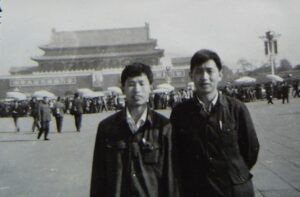
After the interview, I felt good about it and breathed a sigh of relief. Neither my father nor I had ever been to the capital before; our spirits were extraordinarily high, and we threw ourselves into visiting several famous sights without pause. At Tiananmen Square, we even bought a simple camera and took a photo.
At the ticket office in front of Qianmen, we stood in a long line to buy tour bus tickets for the Great Wall. The young woman in front of us was willowy and poised, graceful in manner, and she spoke standard Mandarin. She explained the differences between the various tour buses — the air-conditioned luxury coaches versus the ordinary public-transit-style buses. I was completely captivated by her elegance, and thought to myself: who cares about luxury or ordinary, as long as I can be on the same bus as her. Unfortunately, when we boarded later, I didn't see her, and a sense of loss settled in my heart. Despite that disappointment, seeing the Great Wall for the first time still overwhelmed me with its grandeur. Climbing up, exhausted and parched, Dad brought out the beer he had bought along the way and we drank it together. That was my first time drinking beer. I found the taste bizarre and hard to swallow, but I was too thirsty to be picky, so I used beer in place of water, all the while gazing into the distance at the Wall stretching to the horizon, with nothing but vastness as far as the eye could see.
Seeing that graduate school was looking promising for me, Dad was in especially good spirits. He told me: we still have money left over — let's fly back! In those days, this was an extravagant luxury beyond imagination. I had never even ridden in a car before, and now I was jumping straight to an airplane — I was beside myself with excitement. Unfortunately, the plane tickets were sold out. I never did get to fly, but the euphoria my father and I shared on that trip is something I can never forget.
Then came those months after receiving the acceptance letter — like months of walking on clouds. It was an indescribably wonderful feeling. Never in my life had I experienced such lightness and joy, such freedom from worry. I genuinely didn't know how to express the happiness, so I simply went climbing mountains by myself, from one peak to the next, letting the thorns tear my skin and draw blood, savoring the stinging thrill. For days on end, I climbed every day until I couldn't move anymore. In September I entered Beijing, my mood matching Li Bai's poem: "Laughing up at the sky, I strode out the door — how could I be one of those who live among the weeds?" (Li Bai, "Farewell to My Children at Nanling as I Enter the Capital").
For a middle-school teacher from a small southern mountain town, the graduate school exam truly was the only path to changing one's destiny. These dramatic ups and downs, these extraordinary experiences and emotions — they were all proportionate to the exam's importance. But looking back, having an exam determine your entire life necessarily requires luck, and luck doesn't always hold. At the time, perhaps I didn't notice the peculiarity of this particular program and its specific requirements; perhaps the program had already filled its quota in previous years and would not have recruited again. If Secretary Liu at the Institute of Linguistics hadn't been so dedicated, I might well have stayed forever in that small town. On the other hand, life cannot be measured solely by so-called career success — it should be assessed holistically, by quality of life and each person's own satisfaction with living. As long as basic needs are met, it's very difficult to judge from the surface whether a life is good or bad. They say that for a considerable stretch of time in China, farmers in the Northeast lived the most contented lives, free of pressure — because the land was vast and fertile, even extensive cultivation yielded decent returns, and they could fully enjoy the idyllic life of "ten acres of land, two oxen, a wife and children, and a warm kang bed." On a global scale, life satisfaction is reportedly highest in relatively poor India (where religion plays a major spiritual role), while the most miserable life experience is in Japan. A Japanese friend of mine, who once worked at a machine translation company, told me that despite the good salary, it was an inhuman existence: she watched as several colleagues had mental breakdowns, and some committed suicide. She later went to Australia for graduate studies — she became a poor student, but felt as if she had escaped from a sea of suffering.
Written on May 28, 2004, in Buffalo, USA
朝华午拾 · 我的考研经历
【立委按】从写作时间上看,这是我《朝华午拾》怀旧系列的第一篇,从此一发不可收。回想起来,人的一生,高考和考研的"跳龙门"确实是命运的根本转机。最近探亲,老哥和师姐都跟我说,同辈人后来的生活道路,大多在冲刺龙门的那一刻就注定了。这很不公平,因为很多同学所具有的才干和潜力,应试教育是不能全面衡量的。但是,社会就是这样来鉴别的,本质上还是科举制度。机会和资源最终落在少数幸运的跃过龙门的同学身上,让人不胜唏嘘。
毕业那年,跟大家一样,考研究生,报南京大学外语系英美文学专业。一败涂地。我们的教育怎么能跟南大比。后来到社科院,有一个苏州女同学就是南大外语系77级,她告诉我,那一年研究生考试奇难,报名人数特多,大多成绩低得不可思议。我第一次尝试就碰了个硬钉子。那一年,我们班级就考上一个,上海男生,去了安徽大学外语系。
毕业后分到离家不远的邻县繁昌中学教书,有两点体会:首先,我不适应教书,尤其是低年级和程度差的班级("坏班"),主要是压不住阵,没有办法对付调皮的孩子,上课跟上刑场似的。(教重点班或者高中课还好,学生比较佩服和尊重我,感觉良好。)其次,老当心时间长了,控制不好,会和女学生发展出不合适的关系或感情纠葛。也许是生理原因,女生在初中很容易仰慕年轻男教师,这时候,如果男教师把握不住,就容易犯错误。繁昌中学曾有先例,结果很悲惨,师生双双跳楼,男教师肝脑涂地。
唯一的出路是考研究生。于是,拿来报考手册,翻来翻去,发现中国社科院语言研究所有一门机器翻译专业,要求很特别:考两门外语,语言学,高等数学,离散数学,政治和综合考试。觉得有戏,可以扬长避短,毕竟在我们的年代,会数学的人还懂两门外语,几乎没有,而会外语可以考数学的人也难得。我学过高等数学,只是没有听说过离散数学,问了一些人,各有各的理解,也是一头雾水。至于机器翻译是个什么玩意儿,也高深莫测,就去请教在南陵二中教数理的一位老师。这位老师与众不同,爱读书,很通达,有自己的见解。他非常肯定地说,"这个专业好,是个交叉学科,容易出成就。学科本身很实用,有前景。"他这一番洞见,使我坚定了主攻方向。
这一次考研,仍然不中,主要坏在"综合考试":语言所借用北京大学中文系的试卷,从中文系各科抽选题目,考什么毛主席《在延安文艺座谈会上的讲话》发表在哪一年,等等,缺德透了,非中文系的人明摆着吃亏。好象"离散数学"也栽了。但是北京还是派人到繁昌对我做了外调,证明我已经擦边。这给了我很大信心,至少不是在黑暗中摸索了。也知道我的扬长避短的策略是对的,不然,偌大的中国,为什么我考栽了还有幸被外调呢?很显然,更多的人考的还不如我(后来知道确实如此,那一届该专业一个也没有达标,这才有下一年接着再招)。
第二年再战,准备仍然辛苦,但目标很明确。父亲从邻居处借了一个清静的小屋给我,明令任何人不得打扰。我除了数学习题一本本地做,对于文科,就把一些关键概念的解说录下音来,不分昼夜反反复复地听。什么是历史比较语言学,什么是成分分析法和结构分析法,什么是转换生成语法,表层结构和深层结构的区别,等等等等。复习累了,我常到城墙头外的田地去看黄灿灿一望无际的油菜花,透透新鲜的空气。好多次都在路上遇到父亲,跟我说:"去散散步好,休息一下大腿"。目光里满是赞许和鼓励。
考研要去邻县的考场。父亲送我到车站,临上车前,天气有点转凉,开始刮风了。父亲把自己的呢子中山装脱下(呢子服算是父亲最高级的外套了),给我披上。在车上看到父亲在冷风中挥手,这就是刻印在我脑海里的拐弯处的回头。到邻县宣城考场,住在一个简陋的招待所,一连考三天,下场后精疲力竭,直想哭。晚上钻进电影院,可找到发泄场所了。演的是两个国产短片,艺术水平很一般,但是好在有一点悲剧意味,于是跟着剧情,从头哭到尾,直哭得天昏地暗,但是非常非常痛快,好象把积压了很久的情绪释放出来了。
好事多磨。我的面试通知(挂号信)在邮局丢了,邮递员明知丢了(有记录),也知道我是收信人,却想蒙混过关,并不通知我。多亏语言所秘书刘老师办事严谨负责,给我的中学挂了长途(一辈子感激刘老师!)。当年的通讯可不像现在,这个长途挂了一上午才通。刘老师告诉我们校长,今天应该是我面试的日子,怎么不见人。看我山高路远,可以再作安排,但务请火速来京面试。后来,失职的邮递员看见事情败露,托熟人请求我们高抬贵手,不要追究他的责任。贵手倒是高抬了,但他可知道,这一失职可不当紧,差点断送了我的前程,其严重程度无异于谋财害命。
北京面试催得急,父亲决定全程护送。当年的火车厢象30年代的闷罐车,人满为患,烟雾弥漫。有爸爸在身边照顾,弄吃弄喝,我一路上得以一心扑在随身携带的复习资料上,准备最后的冲刺。
面试完,感觉良好,松了口气。父亲和我都是第一次来首都,兴致特别高,马不停蹄地游玩几个著名景点,在天安门前还买了一个简易相机留了影。我们在前门前的售票处,排长队买去长城的旅游车票。排在我们前面的是个女生,亭亭玉立,落落大方,说一口普通话。她跟我们解释不同旅游车的区别,带空调的豪华车和公车一样的普通车等等。我被她的风度迷住了,心里想,管他豪华普通,能跟她同车就好。可惜,后来上车没有看见她,心里失落落的。尽管有缺憾,第一次玩长城,还是被它的气势所震撼。爬上长城,又累又渴,父亲拿出在路上买的啤酒我们一块喝。这是我第一次喝啤酒,觉得味道很怪,难以下咽,无奈太渴,只好以酒代水,一边极目远眺,看长城内外,惟余莽莽。
父亲看我读研有望,心情特别好,跟我说,带的钱还剩不少,我们坐飞机回去!这在当年是极大的奢侈,我那时侯连轿车都没有坐过,一步登天去坐飞机,兴奋莫名。不巧的是,飞机票卖完了。飞机没坐上,但那次旅行,父亲和我的欣快情绪,难以忘怀。
再后来就是接到录取通知后的几个月腾云驾雾的日子,那真是一种不可言传的美妙感受。一辈子从来没有过如此的轻松愉快,无忧无虑。真的不知道怎样表达喜悦,干脆一个人爬山,从一个山头到另一个山头,任由荆棘刺破皮肤,滴着鲜血,享受火辣辣的快意。连续几天,每天爬山到不能动为止。九月进京,心情同李白:"仰天大笑出门去,我辈岂是蓬蒿人"(李白·《南陵 别儿童入京》)。
对于一个南方山城的中学教师来说,考研确实是改变命运的唯一途径。这些跌宕起伏,非凡的经历和感受,跟考研的重要性是相称的。但是,回想起来,考试定终身必然需要运气,而运气并不总有。当时也许没有注意到这个特别的专业和特别的要求,也许该专业前几年已经招到了,不再招生,如果语言所的刘秘书工作不是那样尽心尽力,我很可能永远留在那个小城里。另一方面,生活也不能仅仅看所谓事业有成,应该总体来看生活质量和各人的自我生活满意程度。在确保温饱的前提下,很难从表面评价人生的好坏。据说,在中国相当一段时间,东北农民,活得最滋润,没有压力。因为土地肥沃广大,广种薄收也有不错的所得,可尽情享受"十亩地,两头牛,老婆孩子热炕头"的世外桃源生活。在世界范围,据报道生活满意度最高的是比较贫穷的印度(宗教起了很大的精神作用),而生活感受最差的是日本。我的一名日本朋友,以前在一家机器翻译公司工作过,告诉我,尽管薪水好,却是非人的日子:她眼看几个同事有的精神跨了,有的自杀了。她后来去澳大利亚读研究生,成了穷学生,却有跳出苦海的感觉。
记于2004年五月28,美国水牛城
From 朝华午拾 / Morning Glory at Noon. Original Chinese: 我的考研经历.
