WEIYANG SOUND · 未央声场
东皇太一·傣族阿妹
吉日、玉佩、兰蕙、桂酒与鼓瑟把一场迎神礼仪写得有声有香。傣族阿妹没有假装复原战国祭歌,而用一副当代虚拟女声,让古典仪式文本与今天的副歌彼此照见。
傣族阿妹 · 中文演唱 · 繁体来源歌词字幕 · 2:28 · 完整播放
Donghuang Taiyi · Dai Amei
屈原《九歌·东皇太一》选句与当代副歌 · 傣族阿妹
作品说明
完整听傣族阿妹《东皇太一》:2:28《楚辞·九歌》仪式慢歌与完整竖屏来源歌词影像。精确 Suno 作品、公开 Persona、完整 MP3 / MV、封面和时间戳均已核实;原典实际保留十四行、遗漏“灵偃蹇兮姣服”,现代前奏与副歌另行标明。
Work note
Hear Dai Amei's Donghuang Taiyi in full: a 2:28 Mandarin ritual ballad and complete vertical source-lyric film. The exact Suno work, public Persona, MP3, film, artwork and timestamp are verified; fourteen of the classical poem's fifteen lines remain, with one omitted line and the modern intro and refrains identified separately.
01 · A RITE MADE OF SOUND AND SCENT
这不是给神明画肖像,而是用香草、玉声与音乐准备一次到来
《九歌·东皇太一》把仪式写成连续动作:择吉辰、抚玉饰长剑、设瑶席、陈兰蕙、奠桂酒椒浆,再举槌击鼓、舒缓节拍、排列竽瑟。文本的中心不是解释东皇太一“长什么样”,而是让供奉、声音、芬芳与参与者的期待逐层会合。歌曲保留了这条从陈设走向五音繁会的路线,因此庄重感不只来自宏大音色,也来自物与动作被一个个叫出名字。
This is not a portrait of a god, but the preparation for an arrival through fragrance, jade and music
Donghuang Taiyi from Nine Songs builds a rite through successive acts: choose an auspicious hour, carry a jade-adorned sword, prepare the precious mat, arrange fragrant plants, offer cassia wine and peppered drink, then raise the drumstick, ease the pulse and set out yu pipes and se strings. Rather than describing what the ritual recipient looks like, the poem lets offerings, sound, fragrance and expectation converge. The song retains that movement from preparation toward the meeting of the five tones; its gravity comes not only from scale but from naming each object and action.
02 · FOURTEEN LINES, NOT THE WHOLE POEM
原典十五行保留十四行;“灵偃蹇兮姣服”没有出现在来源歌词里
来源把屈原文本放入三个 [原文] 区段和 [Final Refrain],实际唱出十五行原典中的十四行;“灵偃蹇兮姣服”被省略。它还加入 [Intro] 的“清风入兰堂”,以及“东皇来兮,满堂芳”“兰风起,玉声长”“阿妹轻歌迎上皇”“一声清歌到天光”等现代句子;“五音纷兮夜未央”则改写自“五音纷兮繁会”。本站不会用“完整原文”包装这版,而把保留、遗漏、改写与新增分别说清。
Fourteen of fifteen classical lines remain; the source lyric omits the line about the spirit-medium's beautiful attire
The source places Qu Yuan's text inside three [Original Text] sections and the [Final Refrain], singing fourteen of the poem's fifteen lines. It omits 灵偃蹇兮姣服, the line describing the spirit-medium's graceful bearing and fine attire. The [Intro] and refrains add present-day lines about clear wind entering the orchid hall, Donghuang arriving, orchid wind, Dai Amei welcoming the high god and a clear song reaching daylight; another line adapts the original meeting of five tones into a night-not-yet-ended image. The archive does not market this as the complete source poem: retention, omission, adaptation and addition stay separate.
03 · DAI AMEI CROSSES INTO CHU CI
第五套完整代表作打开《楚辞礼魂与橘颂》,也把虚拟歌手的文化边界抬得更高
精确作品绑定公开 Persona“傣族阿妹”,曲库将它收在《楚辞礼魂与橘颂》专辑。来源参数把 clear female vocal、葫芦丝、竹笛、古琴与轻柔仪式鼓放在一起,这是 William Lee 的当代跨文化声音设计,不是战国楚地乐制、东皇太一祭仪或现实傣族声腔的复原。傣族阿妹可以作为持续虚拟主唱进入不同文学世界,却不能因此代表楚文化传承者、现实傣族女性或任何宗教社群。正是把这种边界写清,她才可能从一次“民族风”效果成长为有作品连续性的主打歌手。
A fifth complete signature opens the Chu Ci: Ritual Souls and Ode to the Orange album—and raises the cultural boundary
The exact work binds the public Dai Amei Persona and the catalogue places it in the album Chu Ci: Ritual Souls and Ode to the Orange. Source parameters combine a clear female vocal with hulusi, bamboo flute, guqin and a soft ceremonial drum. That is William Lee's contemporary cross-cultural sound design—not a reconstruction of Warring States musical practice, a Donghuang Taiyi rite or a living Dai vocal tradition. Dai Amei can travel as a continuing virtual lead across literary worlds without representing Chu-culture tradition bearers, real Dai women or a religious community. Naming that boundary is what allows her to grow beyond a one-off ‘ethnic’ effect into a lead artist with continuity.
04 · THE COMPLETE SOURCE FILM
影片标题仍是《吉日兮辰良》;白花、青瓷与幽暗拱廊守到最后,但不是楚地实景
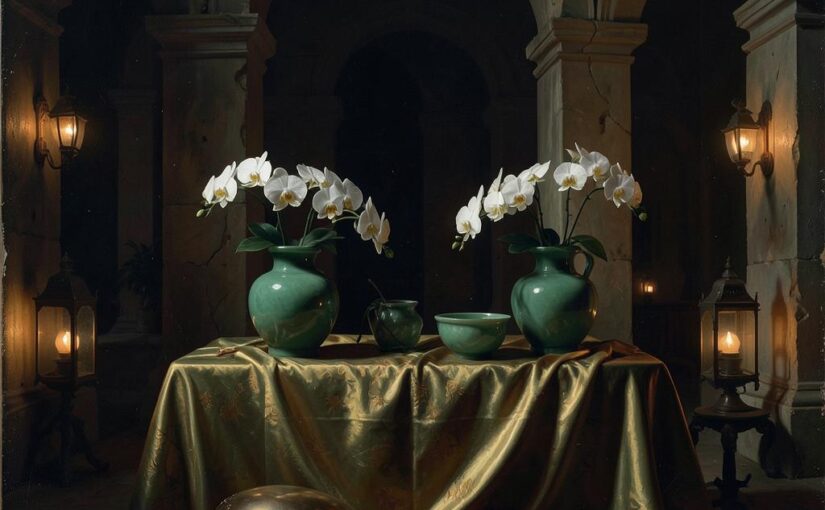
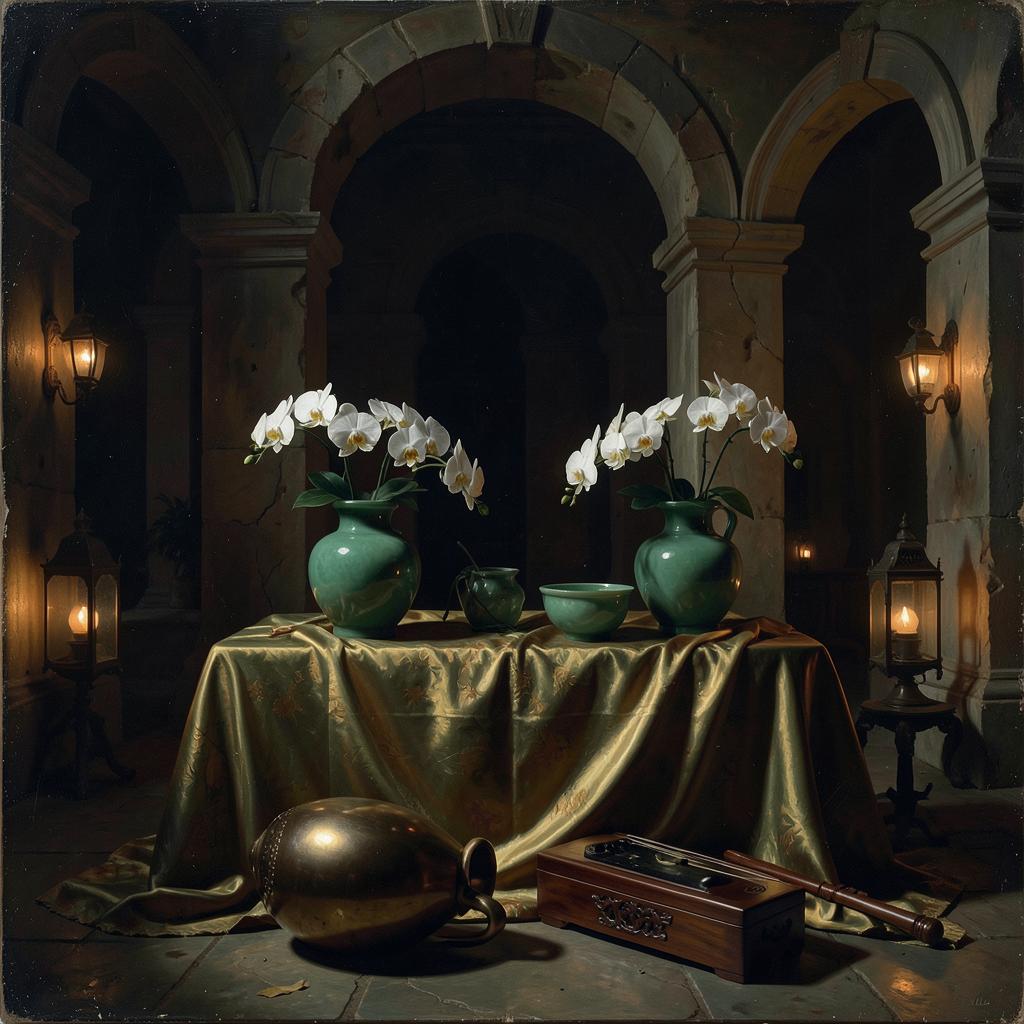
本站完整解码 2:28 MP3 与 147.605 秒影片,并抽查 2、48、96 与 144 秒画面。824×1464 竖屏影像始终使用同一张方形来源图:幽暗拱廊中,白花、青绿色器皿、金色桌布与地面器物被灯火照亮;画面标题使用 Suno 来源名《吉日兮辰良》,歌词由 [Intro] 走到 [Final Refrain],by @liwei 与 Made with Suno 保留。48 kHz 立体声 MP3 与 H.264 / AAC 影片全程解码通过,音画时长相差约 0.275 秒,Suno 接口标记 video_is_stale=false。它是一套完整来源歌词电影,但建筑、器物和花材没有可核实年代或地点,不能冒充楚地遗址、祭器考据、现实仪式或人物表演。
The film title remains Auspicious Day, Fortunate Hour; white flowers, green vessels and a dark arcade endure to the end without becoming Chu documentary footage
The archive decodes the complete 2:28 MP3 and 147.605-second film and checks frames at 2, 48, 96 and 144 seconds. One square source image remains throughout the 824×1464 vertical film: white flowers, green vessels, gold cloth and objects on the floor lit inside a dark arcade. The on-film title preserves Suno's source name, Auspicious Day, Fortunate Hour; captions travel from [Intro] to [Final Refrain], with by @liwei and Made with Suno intact. The 48 kHz stereo MP3 and H.264 / AAC film decode from beginning to end, differing by about 0.275 seconds, and Suno reports video_is_stale=false. This is a complete source-native lyric film, but its architecture, vessels and flowers have no verified date or location and are not presented as a Chu site, archaeological reconstruction, living rite or performer footage.
歌词 · Lyrics
吉日兮辰良,
清風入蘭堂。
[原文]
吉日兮辰良,
穆將愉兮上皇。
撫長劍兮玉珥,
璆鏘鳴兮琳琅。
[Instrumental Interlude]
[原文]
瑤席兮玉瑱,
盍將把兮瓊芳。
蕙肴蒸兮蘭藉,
奠桂酒兮椒漿。
[Refrain]
東皇來兮,滿堂芳,
五音紛兮夜未央。
蘭風起,玉聲長,
阿妹輕歌迎上皇。
[原文]
揚枹兮拊鼓,
疏緩節兮安歌。
陳竽瑟兮浩倡,
芳菲菲兮滿堂。
[Final Refrain]
五音紛兮繁會,
君欣欣兮樂康。
東皇來兮,滿堂芳,
一聲清歌到天光。
影像场景
仪式感开场
楚辞入门
安静而庄重地听
Film scenes
a ceremonial opening
a doorway into Chu Ci
quiet, stately listening