WEIYANG SOUND · 未央声场
南风知我意
折梅、采莲、登楼与望鸿把相思写成一连串动作;到了“南风知我意,吹梦到西洲”,等待终于把现实交给梦。这首新唱保留原诗的水路,也公开标出今天添写的副歌。
傣族阿妹 · 中文演唱 · 4:12 · 完整播放
The South Wind Knows My Heart
南朝乐府民歌《西洲曲》选段与当代副歌 · 傣族阿妹
作品说明
完整听傣族阿妹《南风知我意》:4:12 中文古诗新唱与完整竖屏歌词影像。歌曲选唱《西洲曲》二十六行并加入当代副歌;精确 Suno 作品、公开 Persona、来源标签、封面和时间戳均已核实,虚拟声线不冒充现实傣族传统。
Work note
Hear Dai Amei's The South Wind Knows My Heart in full: a 4:12 Mandarin re-imagining and complete vertical lyric film. It sings twenty-six lines from Xizhou Qu alongside a disclosed contemporary refrain, with exact Suno work, public Persona, source tags, artwork and timestamp verified without claiming reconstruction of living Dai tradition.
01 · THE POEM IN MOTION
《西洲曲》不是一句网红金句,而是三十二行不断移动的相思
《西洲曲》是南朝乐府民歌名篇,全诗三十二行,从忆梅、折梅、渡桥、暮鸟和开门,走到采莲、藏莲、望鸿、登楼、垂手与卷帘。人物很少直接解释心情,细小动作和四季水路替她说话。本作选唱开头二十四行,再接回结尾“南风知我意,吹梦到西洲”两行,共二十六行;中间六行没有被录入,页面因此不把这版误称为全诗逐字演唱。真正被保留下来的,是一颗心怎样从门前走到南塘,再从高楼把梦托给南风。
Xizhou Qu is not one shareable quotation but thirty-two lines of longing in motion
Xizhou Qu is a celebrated Southern Dynasties yuefu folk song of thirty-two lines. Remembering and breaking plum blossom leads to a ferry, evening birds, an opened door, lotus gathering, a lotus hidden in a sleeve, passing geese, a high tower, lowered hands and a raised curtain. Feeling is rarely explained directly; small actions and a seasonal water route speak for the waiting figure. This recording sings the opening twenty-four lines and then returns to the final two—twenty-six lines in total—while omitting six lines in between. It is therefore not presented as a line-for-line performance of the whole poem. What remains intact is the movement from doorway to southern pond and from tower to a dream entrusted to the wind.
02 · THE NEW REFRAIN
“我的心也清如水”来自今天;把新增句子说清楚,古诗才不会被悄悄改写
来源歌词用 [原诗] 标出选唱段落,又在 [Refrain] 和 [Final Refrain] 加入“我的心也清如水”“一声阿妹绕心头”两句,并重复原诗的“莲子清如水”和结尾名句。前者把莲子的双关与相思拉近现代抒情歌,后者把虚拟歌手人物写进收束。这是可以讨论成败的当代改写,不是佚名原作,也不该借古典光环隐藏作者今天做出的选择。页面把原诗、重复句和新增句分开,正是为了让跨时代创作拥有诚实的接缝。
‘My heart too is clear as water’ belongs to today; naming new lines protects the old poem
The source lyric labels selected passages [Original Poem], then adds two present-day lines in its refrains: ‘my heart too is clear as water’ and ‘one call of Amei circles the heart.’ It also repeats the poem's lotus-seed image and famous closing couplet. The first addition draws the lotus pun and longing toward modern ballad language; the second writes the virtual singer into the ending. This is a contemporary adaptation whose success can be debated—not a line by the anonymous original author. Separating original, repetition and addition keeps the seam between eras honest.
03 · THE VOICE AND ITS BOUNDARY
傣族阿妹是虚拟歌手;葫芦丝与竹笛是创作参数,不是民族学证明
精确 Suno 作品绑定公开“傣族阿妹” Persona,曲库也把本作与《风荷举》《山鬼》《湘夫人》等持续登记在她名下,因此她不是一次性的“民族女声”按钮。来源标签写出 delicate clear bright vocal、hulusi、bamboo flute、guqin 与 soft strings,说明这次怎样为古诗设计清亮、慢速、带水感的声场;这些标签却不能证明作品复原了现实傣族音乐,更不能替任何真实社群发言。网站把她作为主打虚拟歌手认真运营,也同样认真保留人物创作与活态传统之间的边界。
Dai Amei is a virtual singer; hulusi and bamboo flute are creative parameters, not ethnographic proof
The exact Suno work binds a public Dai Amei Persona, while the catalogue repeatedly assigns her this song, Lotus in the Wind, Mountain Spirit, Lady of the Xiang and more. She is not a one-off folk-voice switch. Source tags specify a delicate, clear, bright vocal with hulusi, bamboo flute, guqin and soft strings, revealing how this arrangement builds a slow, water-lit setting for the poem. Those parameters do not establish a reconstruction of living Dai music or authority to speak for any real community. The archive develops her seriously as a lead virtual singer while preserving that equally serious boundary.
04 · THE COMPLETE SOURCE FILM
梅枝与荷花唱到最后一个“西洲”;完整,也保留原生字幕痕迹
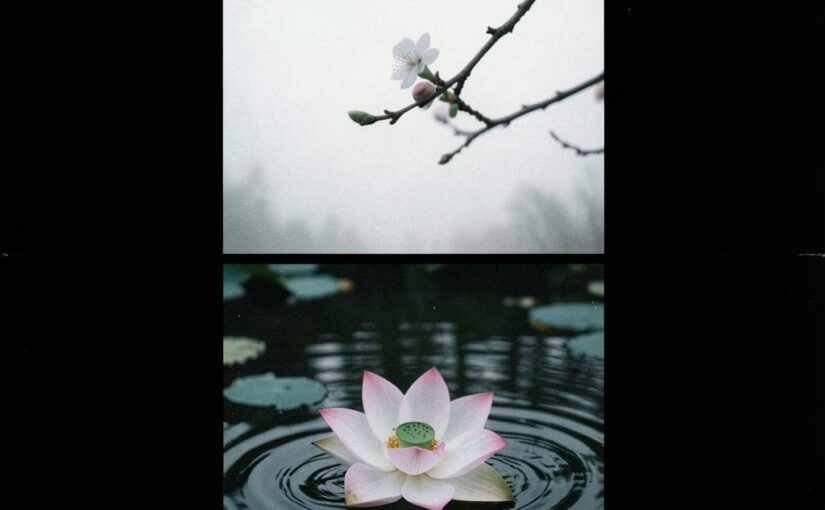
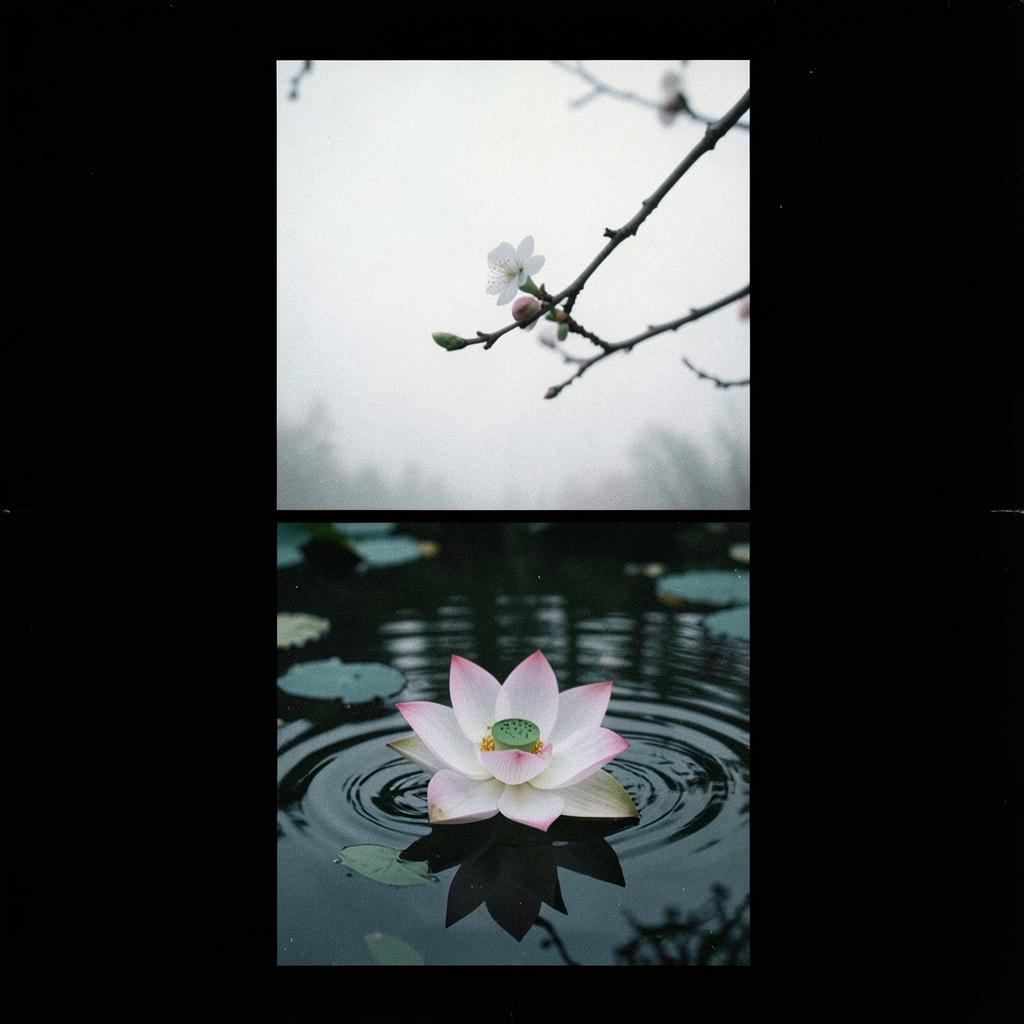
本站完整解码 4:12 音频与影片,并检查片头、中段与尾声。梅枝和水中荷花的上下双联方形封面贯穿 824×1464 竖屏影像,歌词从“忆梅下西洲”走到最后“吹梦到西洲”;by @liwei、Made with Suno、[Intro]、[原诗] 与 [Outro] 等标记仍然可见。音画时长只差约 0.036 秒,因此它确实是一套可从第一声播放到最后尾音的完整媒体;同时,它仍应被准确称为 Suno 来源原生歌词电影,不冒充独立实拍、古装叙事、傣族表演或人工精校字幕 MV。
Plum branch and lotus reach the final ‘Xizhou’—complete, with source-caption traces intact
The archive decodes the complete 4:12 audio and film and checks opening, midpoint and final frames. A two-panel square image of plum branch above water lotus remains throughout the 824×1464 vertical film, while the lyric travels from remembering plum at Xizhou to the final dream carried there. by @liwei, Made with Suno and cues including [Intro], [Original Poem] and [Outro] remain visible. Audio and film differ by only about 0.036 seconds, confirming an end-to-end media set. It is still accurately labelled a source-native Suno lyric film—not independent live action, costume narrative, Dai performance or a human-captioned music video.
歌词 · Lyrics
憶梅下西洲,
折梅寄江北。
[原詩]
憶梅下西洲,
折梅寄江北。
單衫杏子紅,
雙鬢鴉雛色。
西洲在何處?
兩槳橋頭渡。
日暮伯勞飛,
風吹烏臼樹。
[間奏]
[原詩]
樹下即門前,
門中露翠鈿。
開門郎不至,
出門采紅蓮。
采蓮南塘秋,
蓮花過人頭。
低頭弄蓮子,
蓮子清如水。
[Refrain]
蓮子清如水,
我的心也清如水。
南風知我意,
吹夢到西洲。
[Instrumental Interlude]
[原詩]
置蓮懷袖中,
蓮心徹底紅。
憶郎郎不至,
仰首望飛鴻。
鴻飛滿西洲,
望郎上青樓。
樓高望不見,
盡日欄杆頭。
[Final Refrain]
南風知我意,
吹夢到西洲。
蓮子清如水,
一聲阿妹繞心頭。
[Outro]
南風知我意,
吹夢到西洲。
影像场景
雨后水边
想念远方的人
从古诗进入慢歌
Film scenes
waterside after rain
missing someone far away
entering slow song through poetry