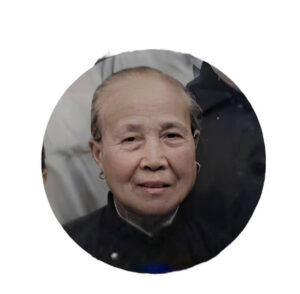
Nearly half a century has passed since my grandmother left us, yet her gentle, kindly face still often comes to mind.
My parents, both doctors, were far too busy with their work. So when their first child was born, Grandmother came to help — and from that day forward, she looked after us three children for fifteen years, until the day she died. I'm told my elder brother was a restless infant. Grandma had to rock his cradle without a moment's pause, humming lullabies the whole time. If she nodded off for even a second and the rope to the cradle went slack, he would wail at the top of his lungs. She later said that child wore her out so thoroughly that she was still anxious when I arrived two years later. But to her surprise, I turned out to be a remarkably quiet baby — I never cried at all. The trouble with me was that I was pitifully frail, constantly falling ill. Every sickness brought vomiting, often with high fever. I had night blindness too, and worst of all, a rectal prolapse that made every trip to the toilet agonizing and messy. Grandma would have to carefully push the prolapse back in each time. She had given birth to ten children in her lifetime, more than half of whom had died young. Looking at me, she worried constantly that I wouldn't survive either. Fortunately, being born into a doctor's family meant I received prompt treatment whenever I fell ill, and with Grandma's devoted care, I slowly made it through my sickly childhood. A child blessed with a grandmother's care is a fortunate child. Grandma kept our home immaculate and orderly, with hot meals always ready. Our childhood was carefree, and our parents, freed from domestic worries, could pour themselves completely into their work, day and night.
Grandma was a woman of the old order — she had bound feet, had never been to school, spoke little, and possessed a gentle disposition. I never once saw her lose her temper. For over a decade, her life followed the same steady rhythm: she never left the house, diligent and unassuming, asking nothing of the world, and all our neighbors sang her praises. Every morning before dawn, Grandma would rise, wash, and dress herself with care — always neat and tidy as she began the day's work. Looking after the children, cooking, never a moment's rest. In her rare spare time, she would sit by the door and stitch shoe soles. She would paste together scraps of cloth, dry them in the sun, then sew them with endless stitches into firm, solid soles — every cloth shoe our whole family wore was made by her hands. After she passed, she left behind a large box of soles that we continued to wear for years, until eventually we began buying plastic-soled shoes instead.
Each month, my parents gave Grandma three yuan as pocket money for us children. She was tight-fisted with it — she had to make it last all three children to the end of the month. I remember I could coax two or three fen out of her each day, and I would often go to the street vendor to buy a small steaming hot sweet potato, then come home and share it with my little sister. I told this story to my daughter, and she loved it — she brings it up now and then with a laugh: "When you were my age, sweet potato was only two cents a piece, and you always asked Granny — that's my Great Granny — for two cents to buy one and share with my auntie GuGu, but never with my uncle DaBai."
I remember during the mass travel of the Cultural Revolution, my father and mother joined the tide and went to Shanghai and Hangzhou for over a week. When transportation broke down and they couldn't get home on time, Grandma was left alone with the three of us. Every day the loudspeakers in the street blared out chaotic news — it felt like the world was falling apart. In those days there was no way to get word of travelers' whereabouts, and the whole household waited with straining eyes. Grandma grew desperate and began to weep. When we children saw her crying, we all cried too — young and old alike, terrified of losing our anchor, weeping together in a heap. Even the neighbors wept with us.
The second year of the Cultural Revolution, because Grandma was classified as a "landlord" by origin, the hospital's Rebel faction ordered her to stand in the street every day, hanging a sign around her neck that read "Counter-Revolutionary Landlord Woman." Poor Grandma, trembling on her bound feet, forced to endure such humiliation. This left a deep wound on us children — we simply could not reconcile our kind, gentle grandma with the image of a hated landlord's wife. Fortunately, my parents sensed things were turning dangerous and quickly decided to send Grandma back to her home village to hide. They specially asked Uncle Xu, our family's most trusted friend and a three-generation "poor peasant", to escort her on the journey. When Uncle Xu returned, he told us that Grandma could not comprehend what was happening, and could not bear to leave the three grandchildren. Heartbroken and wronged, she wept the entire way. They traveled by bus, crossed a river by ferry, transferred to a train, then took a small steamer across Lake Chao — and finally had to walk ten li on foot to reach the village. That last walk took an entire day, and she nearly collapsed from exhaustion.
It was a blessing that Grandma was sent home when she was, because the situation soon deteriorated dramatically — armed factional fighting broke out. First, the young Red Guard factions — the "Criticize the Liaison Group" and the "Sweep Away the Black Line Group" — fought street battles with steel spikes and daggers. One clash took place right in front of our house. I remember we were terrified and fascinated at once. We children climbed up to the second story of one of the courtyard houses and watched through the street-facing window. I was timid; I only stole one glance — I saw the two sides facing off with steel pikes — then heard shouts of slogans and the sounds of combat. This was just the early phase of the armed struggle. Later, the two factions set up separate territories and began using real guns and cannons; we would often hear gunfire at night. Our whole family was secretly moved to the headquarters of the "Criticize the Liaison Group", and my parents became the core doctors at that faction's wartime hospital.
When the "Revolutionary Great Alliance" was formed and the factional fighting stopped, my mother brought Grandma back, and we resumed our daily life together. In the months Grandma had been gone, when we came home from school, the door was always locked. We wore keys around our necks and often had to go to the operating room to find our parents and wait until they finished surgery before we could go home. Only when Grandma returned did the house feel like a home again — life became settled and ordered.
Two photos capture this chapter in our family story. The first shows Grandma as I remember her — serene, dignified, in a traditional collar. The second is a family portrait from 1969: all of us, including Grandma and our young aunt, along with our dearest neighbors Mama He and Sister Xiaohui, gathered before the front door of our home.
I was thirteen when Grandmother developed oral cancer — a tumor the size of a goose egg swelled on her right cheek. When it first appeared, we children would often stroke it gently with our small hands, hoping it would slowly disappear. But the tumor only grew larger. Grandma herself said: "This is a poison tumor — I may not recover." In her final days, my uncle and cousin both came from the home village; it was my uncle who mainly tended her bedside. I heard Grandma murmur, "My children are all here now. It's time to go."
When Grandma died, the record said she was seventy-one, but her real age was probably sixty-nine. I remember she once told me she had added two years to her age, adopting my grandfather's age, as a way to remember him. My grandfather had died of starvation in the home village the year I was born, in 1960 — just like my paternal grandfather and my aunt on Dad's side, a victim of the Great Leap Forward. Grandmother never spoke of my grandfather's story, but you could see that she carried his memory with her, silently, in her heart, all those years.
— Written on September 22, 2007, on the eve of the Mid-Autumn Festival
外婆的回忆
我的外婆去世已经快半个世纪年了,可她老人家的慈祥音容仍时常浮现在眼前。
作为医生的父母工作太忙,所以第一个孩子一出生外婆就来帮忙,从此看顾我们三个孩子15年,直到她去世。据说我哥哥小时候不老实,外婆只好摇着摇篮,哼着催眠曲,不敢稍有懈怠,有时候一个瞌睡过去,摇篮牵绳的手一停,他便大哭大闹。外婆说,这孩子带得太辛苦,到两年后我出生的时候,她还后怕。没想到,我小时候乖极了,从不哭闹。就是可怜兮兮的,老害病,每病必吐,常伴有高烧。还有夜盲症,最要命的是脱肛的毛病,每次如厕十分痛苦,一片狼藉,外婆要小心翼翼把脱肛顶回去。外婆一辈子生养过10个儿女,夭折过半,看我这样子,老担心我活不长。还好,因为是医生家庭,有病能及时处理,加上外婆的悉心照看,我慢慢度过了病孱的童年。有外婆照顾的孩子是幸福的,外婆总是把家整理得井井有条,热饭热菜,我们的童年无忧无虑,父母也因此可以没日没夜全力扑在工作上。
外婆是旧式妇女,小脚,没念过书,少言寡语,性情温和,从来没见过她发脾气。外婆的生活十几年如一日,足不出户,刻苦本分,与世无争,街坊邻居无不夸赞。每天一大早,天还没亮,外婆就起床,开始梳洗,她总是把自己收拾得干干净净,开始一天的劳作。看孩子,做饭菜,一刻不停。稍有空闲,她就坐在门前纳鞋底。她把碎布条用浆糊黏上晒干,一针一线纳成结结实实的鞋底,我们全家大小的布鞋都是她老人家做的。一直到她去世,留下的一大箱鞋底,我们还穿了好几年,后来才开始买塑料底的成品鞋穿。
父母每个月给外婆三块钱,作为我们孩子的零用钱。外婆手很紧,因为她要保证这零用钱维持三个孩子到月底。记得每天可以从外婆那里讨来两三分钱,我常常到街头买来一个热腾腾的小红薯头,回家跟小妹分享。这个故事我跟女儿讲,她很爱听,不时拿出来说笑一番:when you were my age, sweet patato was only two cents a piece and you always asked Granny, that is my Great Granny, for two cents to buy one and share with my antie GuGu, but never with my uncle DaBai.
记得文革初期大串联的时候,爸爸妈妈也随大流去上海杭州串联了一个多星期,由于交通堵塞不能按时回家。外婆带我们三个孩子在家,每天听高音喇叭传出各种消息,给人兵荒马乱的感觉。当年通讯不便,行踪无从打听,一家大小望眼欲穿久等父母不回。外婆急了,开始垂泪,我们孩子看见外婆哭了,也都哭了,一家老小怕失去依靠而哭成一团,连邻居也陪着掉泪。
文革第二年,外婆由于地主成分,被医院造反派勒令每天挂"反革命地主婆子"的牌子站街示众。可怜外婆小脚,哆哆嗦嗦,却要受此羞辱。这对我们孩子刺激很大,我们无论如何也无法把慈祥的外婆跟可恶的地主婆联系起来。还好,父母感觉形势不对,很快决定送外婆回乡下老家躲避,特地请我们家的至交三代老贫农的徐叔叔一路护送。徐叔叔回来说,外婆无法理解发生的一切,又舍不得三个孙儿,委屈伤心,走一路哭一路。乘汽车,过轮渡,转火车,再乘小轮穿过巢湖,最后要步行10里才到老家。最后那步行,走了一整天,人几乎瘫软。
幸亏送外婆回了老家,后来的情势越来越遭,武斗开始了。先是两派小将("批联部"和"扫黑线")拿钢钎匕首在街头械斗。有一场械斗就在我家门前,还记得我们又害怕又好奇,几个孩子爬到院子里一家的二楼上,透过临街的窗户观战。我胆子小,只瞄了一眼,看见双方手拿钢钎对峙的样子,然后听到口号声和厮杀声。这还是武斗初期,后来双方割据,拿起了真枪真炮,常常夜里听到枪响。我们全家也被秘密转移到批联部的司令部去了,我父母因此成了批派战时医院的核心医生。
革命大联合的时候,武斗停止,妈妈把外婆接回来了,我们恢复了跟外婆朝夕相处的日子。外婆没来的时候,我们放学回家,家里总是锁着门,我们脖子上挂着钥匙,常常要到手术室去找父母,等父母手术完回家。外婆来了,家才象个家,生活安定而有秩序。
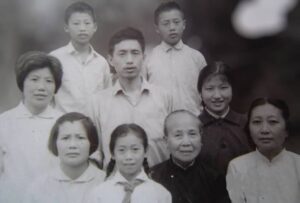 全家包括外婆和老姨,以及邻居至友何妈妈小卉姐在家门前合影,1969
我13岁那年,外婆患口腔癌,右腮长出鹅蛋大一个瘤子。记得瘤子刚起的时候,我们经常用小手抚摸,希望它慢慢消失。可是,那瘤子还是越长越大,外婆自己也说:这是个毒瘤子,怕好不了了。外婆临终前,舅舅和表哥都从老家赶来,最后几天主要是舅舅在床前伺候。我听外婆喃喃说,儿女都在身边,该走了。
外婆去世那年说是71岁,可实际年龄应该是69。我记得外婆生前跟我说过,她虚报了两岁,用的是外公的年龄,为的是做个纪念。外公在我出生的1960年,在老家饿死,跟我爷爷和姑姑一样成为大跃进的殉葬品。外婆虽然从来没有提过外公的故事,可以看出她一直默默在心中纪念着他。
记于2007年九月二十二日中秋节前夕
From 朝华午拾. Original Chinese: 《朝华之五:外婆的回忆》.
