Morning Glory — Ch.3: The Little Red Guards
Before my career began, family and society shaped our character and worldview.
**"Forever Be Chairman Mao's Little Red Guard"**
When the Cultural Revolution began in 1966, I was in the first grade, six years old. More than half a century later, some memories remain as vivid as yesterday.
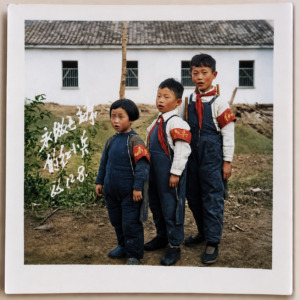
The three of us siblings, wearing our Little Red Guard armbands, photographed in December 1966.
When the campaign to topple Liu Shaoqi began, the first thing I noticed was Liu's official portrait pasted upside down on the street-facing wall, marked with a red cross. Soon after, more and more long banners appeared across the main street: "Burn Liu Shaoqi!" "Deep-fry Liu Shaoqi!" Then, as negative teaching material, they screened the documentary *Liu Shaoqi Visits Indonesia*. The female narration was syrupy sweet, addressing him as "Chairman Liu" and "Jakarta" in every other breath — to my ears, she sounded like a female spy. Her voice was constantly drowned out by the slogans erupting from the audience: "Down with Liu Shaoqi, Defend Chairman Mao!" "Smash the arch-traitor, arch-spy, arch-scab Liu Shaoqi to the ground and trample him underfoot, never to rise again!" Wang Guangmei on screen was dressed conspicuously well, fitting the standard definition of a bourgeois stinking woman. Later, I saw several living newspaper dramas lampooning Liu — his features caricatured into a long horse face, a high-bridged nose, the classic villain's profile. I also remember a living newspaper piece called *Burning Down the British Chargé d'Affaires Office*, which portrayed the Capital Red Guards, righteous in their fury at British imperialism, acting with militant resolve to set fire to the British Embassy — an act of collective heroism (in reality, this was an extremely serious diplomatic incident that caused Zhou Enlai immense trouble and lasting fallout). I still recall the stage effect when they set the fire: they seemed to hurl a torch into the embassy, followed by a loud bang and a plume of thick smoke. I was in the front row and choked on the smoke, coughing hard, and I was genuinely startled. The artistic creativity of the revolutionary masses, producing such vivid stage realism, left a deep imprint on the mind of a six-year-old me.
Around this time came the campaign to "Destroy the Four Old's" (old ideas, old culture, old customs, old habits) and establish the Four New's. Every household voluntarily surrendered items suspected of being "Four Old's" — copper coins, bracelets, ornaments, even ceramic toys of cats and dogs — to be publicly destroyed. The stone lions beside the stone bridge were toppled into the ditch by the young Red Guards; since they couldn't be smashed, chisels were used to disfigure them. The influence spread far: by early 1967, a "Revolutionary Spring Festival" was mandated. Adults had no holiday — they must persist in "grasping revolution and promoting production" — while all New Year celebrations and entertainments were cancelled. Even the traditional four-corner red envelope money for children was voluntarily suspended.
Some elderly people, lifelong habits unbroken, still called matches "foreign fire" and iron nails "foreign nails." These old terms originated in the pre-revolutionary era when China could not even produce matches and nails domestically and had to import them. But by 1966, such old terms could bring trouble. I once saw a tiny-footed old woman totter into a small shop and ask for "foreign fire." The shop assistant replied coldly: "Don't have any." When the old woman pointed to the goods on the counter, the assistant erupted in fury.
Before armed struggle erupted, great debates — the weapon of literary struggle — became prevalent. Even elementary school students debated each other, often turning red in the face. I was too young to get a word in, but I loved listening. What they debated I mostly can't recall, except for one recurring topic: the dialectical relationship between family background and individual performance. The affirmative position was "Heroes beget heroes," while the opposition stressed "What matters is personal conduct." Both sides seemed righteous and indignant, both could quote Chairman Mao's quotations, both seemed to have good arguments. Later, my elder brother took the lead in forming a Little Red Guard revolutionary organization (with a fifth-grader serving as strategist behind the scenes), calling it the "Dagger Squad." Every grade had its representatives. Through this connection, I too was honorably swept up in the revolutionary movement — duties like carrying the paste bucket for the young fighters putting up big-character posters. I remember my brother and his comrades setting up a "Dagger Squad Office" at a table in the corridor of my father's hospital. The squad's most glorious exploit, the one I remember most clearly, was an assault on a school meeting. The squad learned that the school leadership was holding a faculty meeting at seven in the evening and decided on a surprise raid. I had the good fortune to follow my brother on this revolutionary action. I remember the meeting was in progress when the squad burst into the room, shouting: "What kind of black meeting are you holding here?" The leaders, seeing it was a bunch of children, didn't know whether to laugh or cry, and explained that this was a routine school affairs meeting. The squad leader declared: "Then we're attending too." Some leader apparently advised that a work meeting wasn't convenient for students. That set off an explosion. The young fighters, each more righteous than the last, delivered their rebuttals: We are Chairman Mao's Little Red Guards — if we don't attend, who will? You hold black meetings behind the backs of the revolutionary young fighters — how poisonous your intentions must be! Not only will we attend, we demand you honestly hand over all previous meeting records. If you dare not disclose your meeting records, you must have unspeakable criminal aims, and we will rebel against you. And so on. I remember the school leaders finally conceded, agreeing that young fighter representatives could attend all faculty meetings. I was as excited as everyone else, filled with the pride of this initial victory in struggle. Unfortunately, I suffered from night blindness at the time, and on the way back my vision went completely dark. An older girl from a higher grade held my hand and walked me home (my brother, as rebel leader, stayed behind to discuss the next phase of the struggle strategy). This revolutionary action enormously boosted the young fighters' morale and opened the prelude to rebellion against the elementary school leadership, soon followed by a flood of big-character posters exposing the schemes of the capitalist-roaders.
In the early days of the Great Revolution, the three of us siblings, led by our brother every day, would stand before the Precious Book platform for morning pledges and evening reports — earnest and ceremonial, and we kept it up for a long time.
朝华午拾 · 红小兵
职业生涯之前,家庭和社会塑造了我们性格和世界观。父母是天,兄妹是我的依靠和牵挂。
"永做毛主席的红小兵"
一九六六年文革开始的时候,我在小学一年级,六岁。半个多世纪了,有些记忆依然清晰如昨。
兄妹仨臂佩红小兵袖章摄于文革1966年12月8日。
打倒刘少奇的时候,最先是看到临街墙上把刘主席的标准像倒贴过来,打上红叉。后来,看到越来越多的长幅标语在大街上,"火烧刘少奇","油炸刘少奇"。接着,作为反面教材,放映了纪录片《刘少奇访问印度尼西亚》,片子里面的女音讲解,甜腻腻的,一口一个刘主席和雅加达,当时听起来觉得象女特务,不断被场内此起彼伏的口号声淹没:"打倒刘少奇,保卫毛主席!""把大叛徒、大内奸、大工贼刘少奇打翻在地,并踏上一只脚,叫他永世不得翻身!"电影上的王光美,打扮得很光鲜,符合资产阶级臭婆娘的标准定义。再后来,看到过几个批判刘少奇的活报剧,刘的形象被脸谱化,马脸,高鼻子,一副奸臣像。记得同时还有一个活报剧《火烧英国代办处》,演的是首都红卫兵,对英帝国主义义愤填膺,同仇敌忾,机智果断纵火焚烧英国大使馆的光荣业绩(这是一起非常严重的外交事件,给周恩来的工作带来很多麻烦和后遗症)。还记得,舞台上演纵火时的场面,好像是把火把往使馆内一扔,砰一声炸响,一股浓烟就冒出来,我在前排,呛得直咳嗽,也吓了一大跳。革命群众的艺术创造力所造成的舞台逼真效果,在一个六岁孩子幼小的心灵里刻下了深深的印记。
这前后的破"四旧"(旧思想、旧文化、旧风俗、旧习惯),立四新,我们各家各户主动把涉嫌四旧的物品,比如,铜钱、手镯、装饰品,甚至小猫小狗的瓷玩具,统统缴公销毁。石桥旁的石头狮子也被红卫兵小将推倒在河沟,因为实在砸不烂,就用凿子破相。影响所及,67年初要求"过革命化的春节",大人没有节假,坚持抓革命、促生产,同时取消了所有过年的庆祝和消遣活动,连四角压岁钱也自觉停止发放了。
当时有些老人一辈子的习惯改不了,仍然称火柴为"洋火",铁钉为"洋钉"等。老称呼源于旧中国日常生活品连火柴和铁钉都无力生产,需要进口。可是到了66年,这些旧称呼会带来麻烦。我就看到过小脚老太太颤颤巍巍到小卖店要买"洋火",营业员冷冷一句:"没有"。当老人指着柜台里面的商品,营业员就大发雷霆。
武斗开始之前,用于文斗的大辩论开始盛行,连小学生也互相辩论,往往争得面红耳赤。我太小插不上嘴,但是很愿意旁听。辩论什么大多记不清了,但是有一个题目是反复辩论过的:家庭出身和自我表现的辩证关系。正方的论点是"老子英雄儿好汉",反方强调"重在个人表现"。感觉双方都义正词严,都懂得引用毛主席语录,似乎哪一方都很有道理。
后来,我哥哥领头成立红小兵革命组织(背后有个五年级的孩子做军师),叫"匕首小分队",其中各年级都有代表。由于这层关系,我也光荣卷入革命运动,比如给贴大字报的小将提浆糊筒之类。我印象我哥哥一伙还在我父亲的医院走廊尽头,摆了张桌子,设立了"匕首小分队"办事处。小分队的光荣事迹记得最清楚的,是一次大闹会场的事件。小分队得知晚上七点学校领导开教务会议,于是决定来个突然袭击。我有幸跟着哥哥参加了这一革命行动。记得会议进行中,小分队一行冲进屋内,叫道:"你们这是开的什么黑会?"领导看是一帮孩子,哭笑不得,解释说,这是例行的校务工作会议。分队头头说:"那我们也要参加"。好像是某领导劝告说,工作会议,学生参加不方便。这一下炸了窝,小将们个个义正词严予以驳斥:我们是毛主席的红小兵,我们不参加谁参加?你们背着革命小将开黑会,用心何其毒也。我们不但要参加,还要你们老实交出以前会议的所有记录。你们不敢公开会议记录,就肯定有不可告人的罪恶目的,我们就要造你们的反。诸如此类。记得校领导最后让步,同意小将可以派代表参加所有校务会议。我跟大家一样兴奋,充满了斗争初步胜利的豪情。不过,倒霉的是我当时患有夜盲症,回来路上,两眼一片漆黑,是由一位高年级大姐姐,牵着我手送我回家的(哥哥作为造反派头头留下来商量下一步的斗争策略)。这次革命行动极大地鼓舞了小将的斗志,拉开了向小学领导造反的序幕,紧接着是铺天盖地的揭露走资派阴谋的大字报。
大革命初期,我们兄妹三每天在哥哥带领下,在宝书台前,早请示,晚汇报,煞有介事,坚持了很久。
From 朝华午拾. Original Chinese: 《朝华之三: 红小兵》.
