Revisiting: Diverted by the Era, Leveled by the Era

Recently, a fellow PhD classmate commented on my two-minute video from yesterday.

He said: "If I had gritted my teeth back then, given up on that humanities PhD, and thrown myself into the C++ wave of the 90s to become a programmer in Silicon Valley — then today, I would probably be writing a different Liwei 2min: My biggest regret is being led astray by C++, never finishing my PhD."

I replied: "yeh u know." Because I know it too well.

Others thought it was a joke. It wasn't. It was two old-timers, looking at each other across thirty-plus years of life, and then laughing at the same time. Because we both knew. He was talking about himself. And the 'what if' he described — that was me.

Years ago, he left our shared advisor and headed south to Silicon Valley. He went through various startups and big tech companies. Today he still works at a major company, responsible for a product used by hundreds of millions. Riding the wind all the way.

I stayed on the other path. Chasing that 'damn' humanities PhD, I missed the early excitement of the 90s, but caught the dot-com bubble at the turn of the century.

Two different life trajectories. Converging at last in Silicon Valley.

What's interesting is — at this age, we've begun to understand and tease each other more. Perhaps this is the most wondrous thing about human nature. What you have slowly becomes taken for granted. What you don't have keeps appreciating in memory.

When young, we thought life was a multiple-choice question. Later we discovered — life is actually a question of what you give up. Every time you choose or are chosen for one answer, you simultaneously give up countless alternatives.

And those abandoned or rejected answers — they'll keep coming back to knock on your door, years later. Telling you: maybe this was the right one after all.

The truth? Nobody knows. Because life's greatest magic trick is this: real life can only be lived once. But parallel universes can be fantasized ten thousand times.

Reality can never beat fantasy. Because fantasy doesn't have to pay the mortgage. Doesn't have to work late. Doesn't have to face the boss. Doesn't have to face middle-age weight gain. Fantasy forever stays frozen on the most beautiful frame.

So many regrets — it's not really that we chose wrong. It's that we discovered: perhaps, somewhere in the unseen, there truly is fate.

Lately I've been thinking about something else. If our generation's regret is being diverted by the era, chosen by the era — then the younger generation's predicament is even more bewildering and challenging: they are being leveled by the era.

When all doors are open, when all knowledge and skills are at your fingertips, when both humanities and sciences face the same shrinking job market, when new graduate hires become fewer and fewer — the new generation faces not career choices and planning. They face no choices, and no way to plan.

This confusion and helplessness, this inability to find one's place or purpose, is becoming the prevailing sentiment across universities. This is not something a platitude about 'embracing AI' can soothe.

For decades, knowledge was a scarce resource. Whoever possessed knowledge held an advantage. A book. A degree. A skill. Any of these could change your fate.

But after AI arrived, knowledge became like tap water. What once required a trip to the library can now be obtained with a single sentence. Designs that once took a decade of experience can now be generated in minutes.

Is knowledge still useful? Of course it is. But possessing knowledge no longer matters — because everyone can possess it. Just like electricity is essential, but owning a power plant no longer matters — because every household has an outlet.

This is a strange era. Knowledge is no longer scarce. Words are no longer scarce. Even intelligence itself is beginning to lose its scarcity.

What remains in the end — is not knowledge. Not degrees. Not titles. But lived experience.

AI knows what heartbreak is. But it has never waited for that call that never came. AI knows what aging is. But it has never watched its parents grow old day by day. AI knows what regret is. But it has never, at sixty, suddenly remembered a life it didn't choose forty years ago.

Knowledge belongs to machines. Experience belongs to humans. Efficiency belongs to machines. Feeling belongs to humans. Perhaps the most precious thing in the future — is not what you know, but what you have truly lived.

So I've come to feel, more and more — life's greatest regret is neither being diverted too early by the era, nor being leveled too late by the era. It is, after having lived a singular, unrepeatable life, still wanting to live on behalf of another self that never existed.

That guy — let him stay in the parallel universe. As for us — let's keep playing this round to the end.

But most crucially, and what worries me more: in this era of breakneck technological change, how do we build social welfare systems that ensure AI's dividends are shared by all? How do we ensure the next generation no longer faces the challenge of countless doors wide open, yet no path to walk through?

🎬 Watch the video version (YouTube)

再谈被时代分流,被时代平权

再谈被时代分流,被时代平权

最近朋友圈里,一位博士时期的同门师兄评论我昨天的两分钟。

他说:

如果当年我咬咬牙,放弃文科博士,投身90年代的C++洪流,去硅谷当程序员。

那么今天的我,大概会写另一篇《立委两分钟》:

最大的遗憾,是被C++带偏了,没有把博士读完。

我回了一句:

yeh u know

因为我太知道了。

别人以为这是玩笑。

其实不是。

这是两个老帮菜隔着三十多年的人生,对视了一眼。

然后同时笑了。

因为我们都知道。

他说的就是他自己。

而他说的那个"如果",恰恰是我。

他当年离开我们共同的导师南下硅谷。

后来进了各种初创和大厂。现在还在某大厂负责某个用户亿万的产品。一路带风。

而我留在了另一条路上。为那个"该死"的文科博士 错过了90年代早期的热闹 但赶上了世纪末的泡沫。

两条不同的人生道路。最后交汇在硅谷。

有意思的是。

到了这个年龄。

我们开始更加理解和打趣彼此。

这大概是人性最奇妙的地方。

得到的,总会慢慢变成理所当然。

得不到的,却会在记忆里不断升值。

年轻时觉得人生是一道选择题。

后来才发现。

人生其实是一道放弃题。

你每选择或被选择一个答案。

同时也放弃了很多个候选。

而那些放弃或被放弃的答案。

会在未来很多年里。

时不时回来敲门。

告诉你:

也许这才是正确的那个。

事实上呢?

没人知道。

因为人生最大的魔幻就是:

现实人生只能活一次。

平行宇宙却可以幻想一万次。

现实永远比不过幻想。

因为幻想不用交房贷。

不用熬夜。

不用面对领导。

不用面对中年发福。

幻想永远停留在最美好的那一帧。

所以很多遗憾。

其实并不是因为选择错了。

而是因为我们发现:

冥冥之中 也许真有宿命。

最近又想到另一件事。

如果说我们这一代人的遗憾,是被时代分流 被时代选择。

那么年轻人的处境更加茫然和挑战:

他们正在被时代平权。当所有的门都打开 所有知识技能都唾手可得 当文科理科面临同样的职场萎缩 当新人招聘越来越少 新一代面临的不是职业选择和规划 他们面临的是没有选择 也无法规划。这种惶惑和无助 这种找不到自己位置 也缺乏目标的现实困境 正在成为蔓延各大高校的情绪。这绝不是一句要拥抱AI的鸡汤可以平复的。

过去几十年。

知识是一种稀缺资源。

谁掌握知识。

谁就拥有优势。

一本书。

一个学位。

一门技术。

都可能改变命运。

但AI来了以后。

知识变得像自来水。

以前要跑图书馆才能找到的东西。

今天一句话就能得到。

以前需要十年积累才能做出的设计。

今天几分钟就能生成。

知识还有用吗?

当然有用。

但拥有知识已经不再重要了。

因为人人都能拥有。

就像电很重要。

但拥有一个发电厂不再重要。

因为家家户户都有插座。

这是一个很奇怪的时代。

知识不再稀缺。

文字不再稀缺。

甚至连聪明本身都开始变得不稀缺。

人最后剩下的。

不是知识。

不是学历。

不是头衔。

而是经历。

AI知道什么叫失恋。

但它没有等过那个永远不会来的电话。

AI知道什么叫衰老。

但它没有看着父母一天天变老。

AI知道什么叫遗憾。

但它没有在六十岁的时候,突然想起四十年前那个没有选择的人生。

知识属于机器。

体验属于人。

效率属于机器。

感受属于人。

也许未来最珍贵的东西。

不是你知道什么。

而是你真正活过什么。

所以我突然越来越觉得。

人生最大的遗憾。

既不是太早被时代分流。

也不是太晚被时代平权。

而是在拥有了一段独一无二的人生之后。

还总想着去替另一个从未存在过的自己活着。

那个家伙。

就让他留在平行宇宙里吧。

至于我们。

继续把这一局玩完。

但最最关键 更让人忧心的还是

在这急剧变革的技术时代 如何推进社会福利制度的建设 确保AI红利全民共享 确保下一代不再面临无数大门敞开 却无路可走的挑战。

🎬 观看视频版(YouTube)

A Lifetime's Regret: Diverted Too Early by the Times

Thesis: Many people's destinies are determined not by ability, but by the first sorting table their era hands them.

Looking back on my life, I have two deep regrets. By the time large language models arrived to help compensate, the energy and opportunity for frontline battle had already passed. A sigh.

The first regret: Among the Class of '77, many of the brightest were "hijacked" by the window of foreign languages. English was the key to the world — but the ticket was so precious that many spent their entire lives stuck at the ticket gate. I was drafted into the humanities, not because I didn't apply for science. The era made the choice for me.

The second regret: the PhD phase. I had one foot in the door of coding and engineering. OOP and C++ were all the rage, I was hooked. But the thesis and degree pulled me away. I became a self-made manager — VP, Chief, whatever — knowing a little about everything but never again a frontline engineer.

This isn't simple personal regret. It's a sample of an era: when windows of choice are small, a person is shaped not by their interests, but by the shortages of their time.

Today's young people have all the tools. AI, programming, English, expression — everything can be re-learned. The era no longer opens just one door. The only question: with all the doors open, do you dare walk back in?

by Tuya

🎬 Watch the video version (YouTube)

立委两分钟:一辈子的遗憾,是太早被时代分流

回想这一辈子,我觉得自己有两大遗憾。等到大模型能帮助弥补遗憾的时候,一线闯荡的精力和条件已经不再,唏嘘。

第一个遗憾,是 77 级那一代人里,很多最该去打基础科学和工程硬仗的人,被外语这个窗口"劫持"了。这不是说外语不好。恰恰相反,那个年代,没有LLM通天塔,英语就是一把钥匙,是通向世界的门票。问题是,门票太珍贵,以至于很多人一辈子都留在了检票口。

我当年被文科收编,不是因为我没报考理工,大革命后77级的理工考卷我考的是数理化而不是文史。我仗着多年跟着广播英语节目自学的英语,决定加试英语。但制度上你不能把加试英语的人,违背考生意愿,一下子划拉到外语系吧。但生活就是这样,开人生道路的玩笑,没商量。这个意义上,是时代替我做了选择。

可地球人都知道,第一学位太重要了。本科像人生的第一块地基。地基打在哪里,后面的楼就大概率往哪里盖。错过了,也不是不能改,但你要付出的代价就大得多。理科生还能转文科,文科生想回去和理工科硬拼,基本就是赤手空拳上战场。

第二个遗憾,是博士阶段。那时我一只脚已经快踏进 coding / engineering 的门槛了。当时 OOP 和 C++ 特别时兴,我开始入迷。按理说,再咬咬牙,也许就能把自己锻造成一个真正的码农,曾考虑放弃那个该死的文科博士旅程。后来还是被论文、学位牵着走。

再后来,就更没有机会成为一线工程师了。因为我突然成了一个 self-made manager,VP、Chief啥的:什么都懂一点,什么都能说两句,什么坑都踩过一点,但真正坐下来一行一行写代码,已经不是主线。人到中年,记性也差了,系统命令与代码syntax 都记不住。

这不是简单的个人后悔。这是一个时代的样本:当社会资源稀缺、信息通道狭窄、选择窗口很小的时候,一个人很可能不是按照兴趣成长,而是按照时代的短缺被塑形。

今天的年轻人幸运得多,也残酷得多。幸运的是,工具都在手边;残酷的是,借口也少了。现在 AI、编程、工程能力、英语、写作、表达,很多东西都可以重学、现学,都唾手可得。时代不再替你只开一扇门。问题只剩一个:门都开了,你敢不敢重新走进去?

by Tuya

🎬 观看视频版(YouTube)

Morning Glory & Afternoon Memories — Chapter 16: Mourning the Semantic Master, Mr. Dong Zhendong

In 2019, when the devastating news reached me, I was on the road. Stunned beyond words, my head was buzzing. I had just stepped off the high-speed train when my father was the first to relay the message, earlier than any of my WeChat groups. He must have been following the news from the Chinese Information Processing Society of China, the nation's highest academic body for NLP. He had often heard me speak of Professor Dong.

My old friend Nick urged me not to forget to write a memorial piece. Having followed and benefited from the Master for over thirty years, my heart brims with memories — thousands of threads, tangled and endless. Where do I even begin?

Not long after the turmoil of 1989, the Second Summit Conference on Machine Translation was held in Munich, Germany. I attended on behalf of Professor Liu Zhuo, presenting our JFY translation system. Professor Dong was also present. After the conference, we were invited to the multilingual machine translation group at BSO in the Netherlands for their "Chinese Week," to discuss incorporating Chinese into their multilingual framework and to explore the challenges of Chinese language processing.

Many years later, Professor Dong wrote to tell me that his children had been sorting through old photographs and unearthed a group picture from the Netherlands — a precious find. The man in the photo, Witkam, was the BSO project lead. It was he who had secured funding for the machine translation project from the European Community, with BSO covering the other half, which made possible their five-year plan for a multilingual MT system using Esperanto as the interlingua. The Chinese component was the dependency grammar I built for them — entirely a paper exercise, but it did sketch out the rudiments of formalized Chinese. Professor Dong was full of praise and encouragement for this work.
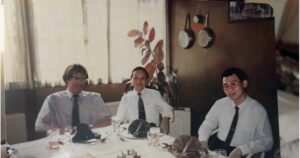

[Photo: Witkam, BSO Multilingual MT Project Lead; Professor Dong; and Li Wei (1989)]

I later sent him back a parting group photo taken during our time together on the machine translation project at Gaoli Company. That stint at Gaoli was a stroke of serendipity — I was able to spend several months working alongside Professor Dong in an office converted from a basement, listening to his teaching firsthand.
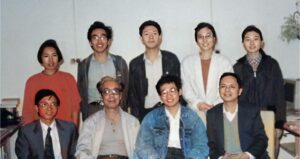

[Photo: Bottom row, left to right: Gaoli CEO; Professor Liu Zhuo; Li Wei; Professor Dong Zhendong (1991)]

In April 2013, Professor Dong wrote back:

Thank you. These photographs are extremely precious to all of us. I was already 54 that year, but my physical and mental vigor were still quite good. Another twenty years have passed. I'm still thinking of challenging myself once more. At the very least, I will keep pushing our HowNet-based MT system forward, to see just how far it can go. When I went back to receive an award, I visited Professor Liu. He mentioned that the institute had suggested he continue to supervise students. He felt he had no research topics and that funding was hard to come by, so he didn't accept. After returning, I thought it over and felt he should perhaps still do something. Who knows — he might break new ground.

I recently received a letter from the society about the 2013 Computational Linguistics Conference. After reading their call for papers, I felt I had something to say. Once I write it, I'll forward it to you for reference.

Has the household been lively? Girls grow up fast — not so easy to manage anymore.

Zhendong

My reply:

April 27, 2013

That must have been during the gestation of HowNet. I remember you mentioned a few ideas at the time.

Last time you mentioned using fine-grained classification to resolve structural ambiguity (the PP-attachment type of problem). It might be feasible with careful work, but I believe the fundamental solution to structural ambiguity lies not in artificial taxonomies but in statistics. Structural ambiguity is, at bottom, a love triangle — which element pairs with which ultimately depends on the relative strength of semantic attractions. And this relative attraction between AC and BC cannot be computed in advance, because there are far too many combinatorial possibilities. However, the attraction weight of AC or BC individually can be learned from large-scale data (essentially, lexical coherence acquisition). If we have a mechanism to bring this statistical information to bear at the moment of structural ambiguity and compare the scores, the problem can in theory be solved. This should be more effective and reasonable than manually tuning with fine-grained semantic features.

In fact, such a mechanism is already implementable. Admittedly, the implementation is still somewhat cumbersome, and the cost needs further investigation.

This visit, I felt that Professor Liu had aged considerably, more frail and slower. I suspect he no longer has the energy required. I understand your meaning — having spent a lifetime in research, even in retirement, it's best not to come to a complete stop, unless one has other passions. Sadly, many of us, aside from building systems, have no other hobbies. Retirement can be lonely.

Your student, Wei

Over more than thirty years of interaction with Professor Dong, beyond exchanging pleasantries about life, what we discussed most was our shared field. Professor Dong was a man of genuine feeling, rich in humor, and he could often make people laugh. I remember once, talking about his "Yi Xing" (TranStar) system, he said: That is my true child — a crystallization of painstaking effort. Then, laughing, he added: "My son and daughter don't count. Why? They're the result of 'natural disasters.'" Yet many years later, he spoke to me again about his children, hoping I might have the chance to bring his son Dong Qiang along to build something together, enumerating the child's strengths and weaknesses. In the end, he couldn't resist adding: "One's own child — even a scabby head is beautiful."

In the history of machine translation in China, my advisor was a true pioneer: Professor Liu Yongquan began assembling a team in 1957-1958, recruiting Professor Liu Zhuo from the Foreign Languages Institute and the late Professor Gao Zushun. Their first successful experiment came in 1959, and the three later co-authored A Brief Introduction to Machine Translation (which Japan later used as a primary reference during its MT research, translating it into Japanese). Professor Dong likely joined the Two Lius' MT project sometime in the 1960s, as a faculty member of the Foreign Languages Department at Heilongjiang University. He held both Professor Lius — who were as much elder brothers as teachers — in the deepest respect. A few years ago, he told me he had visited each of them individually to pay his respects.

Professor Dong surpassed his mentors, later taking the lead at the Academy of Military Sciences in turning MT into deployable, open software, becoming one of the foremost figures in Chinese MT and NLP. Looking at international exchange, for a long period Professor Dong served as China's NLP ambassador, the interface with the global academic community. From the Academy's "Keyan No. 1" — a practical, open English-Chinese machine translation prototype — to its commercial landing at China Software, where the first commercial product "Yi Xing" (TranStar) was launched, he set an example for nearly ten nationwide MT teams: MT could walk out of the laboratory.

Yi Xing was a milestone.

Professor Dong later shared his lessons learned from that experience. The most important one: don't spin your wheels in place. Focus on the big picture and let go of small details. Once R&D reaches a certain stage, rapidly expand the test set, open the system to others for testing, and grow through error. Before Yi Xing, R&D was essentially done on very small development sets — in those days, there was no distinction between development and test sets, and systems were typically not opened to outsiders. Academic evaluation meetings mostly involved drawing a few samples from a closed set. The computing conditions were also poor back then: you'd type in a sentence, and the evaluation committee members would go out for coffee and come back before the results appeared. Professor Dong's "Keyan No. 1" evaluation meeting was the first event to open the system to external expert evaluators for real testing. This took both nerve and courage in those years. I vividly recall accompanying Professor Liu to the Academy to participate in the "Keyan No. 1" system evaluation. Outside the hall, past translation samples and system documentation were on display. Inside the hall, experts challenged the system with various sentences. The open testing made a deep impression on me.

Professor Dong had an excellent relationship with Professor Su Keyi of Taiwan. He told me: "Look at Professor Su — he started a translation company purely out of passion for MT. The software may not be very refined, but he dares to use it boldly and iterate continuously."

At the end of the 1980s, Gaoli Company approached Professor Liu for collaboration, deciding to build a next-generation MT product based on Liu's JFY-IV expert dictionary system. By then, we had already learned from Professor Dong's open practice to pick up our pace. Previously, we could spend one or two years repeatedly polishing just a few hundred sentences.

Professor Dong himself acknowledged that, from a design perspective, Professor Liu's expert dictionary system was superior to Yi Xing and held greater potential. He had been invited to participate in the Gaoli project too, but by then his focus had already shifted — he was beginning to gestate Zhi Wang (HowNet). I clearly recall, during a lunchtime chat, Professor Dong saying that he felt the foundational knowledge resources for machine translation were insufficient, and that we needed to strengthen semantic ontology knowledge from the roots, including common sense. That endeavor lasted thirty years!

Let me explain the international academic background of this project. Professor Dong's approach to MT was built on the deep case grammar framework of the renowned semanticist Fillmore, which he suitably adapted and named "Logical Semantics." He used this framework as the internal structure (interlingua) for translation and transfer, publishing several influential papers demonstrating that this representation was sufficiently deep and well-suited for translation between languages of different families. I, too, was fascinated by deep case theory at the time and deeply convinced by Professor Dong's work — an influence that has persisted to this day, which is why I have always insisted that deep parsing is the principal source of NLP's "nuclear weapons." However, once Logical Semantics had a suitable graph-structure representation, it only resolved the semantic relationships at the structural level. The ontological knowledge of the lexical concepts at the nodes — their intrinsic semantics — had not yet caught up to complete the knowledge system. The most important ontological knowledge includes the subcategorization patterns of predicates with their potential sentence structures, the required argument types, and their roles. For example, the predicate EAT requires two arguments in its subcategorization frame: one demands a human or animal (Logical Subject), the other demands food (Logical Object). This is essentially common sense, requiring an ontological knowledge base to formalize common sense.

And so HowNet was born — finely classifying cross-lingual concepts, encoding human common sense through sememes and their relations, and establishing a formalized ontological knowledge system with logical-semantic representation. It is a work of genius that no ordinary human effort could achieve, a dispensation of divine light upon Professor Dong, and China's gift to human civilization. People in our field speak of how the three pioneers of deep neural networks sat on the cold bench for twenty to thirty years before finally being honored with the Turing Award. Professor Dong sat on the cold bench for over thirty years, and largely remains a hidden treasure unknown to the world. HowNet may well be a Turing-level contribution to human cognition. I believe that someday, when MT and NLU applications have exhausted all the low-hanging fruit of shallow approaches, knowledge systems will be further excavated, utilized, and appreciated.

In those days, WordNet already existed, but that system was led by psychologists and had many things that didn't sit right. Building a conceptual lexicon is grueling labor — few are willing to do it, even fewer are capable, and among those both willing and capable, very few can sustain the effort to complete such an enormous project. Although WordNet was never designed for NLP or MT, for lack of alternatives, when practitioners reached a certain depth and needed to draw on semantic resources, they would still use it, or adapt it. Professor Dong, with his erudition and depth, refused to settle. He had his own system design and his own conviction. He would tear it all down and build anew — a body of ontological knowledge better suited to machine translation and NLP.

Such work only saints and true masters can undertake. The scholarly threshold for ontological knowledge systems is extraordinarily high, encompassing the full spectrum of fundamental concepts, relations, and common sense. Even assuming one has devised a logically coherent and reasonably sound architecture, the work inside it is immensely arduous.

HowNet is Professor Dong's immortal monument.

After I went abroad in 1991, I became a wanderer, drifting from Britain to Canada, with scarce contact with family, friends, and mentors back home. But before I left, Professor Dong wrote me a "letter of reference" to be delivered to the eminent Professor Tsujii, who was then Department Head and director of the Computational Linguistics Center at UMIST (Tsujii was a student of the Japanese MT pioneer Nagao Makoto and the advisor of Li Hang). Professor Dong also wrote multiple recommendation letters for my other study-abroad applications. On the eve of my departure, it was Professor Dong who told me — he said Professor Liu Zhuo had confided that the project had kept Wei around for several years, causing him to miss several opportunities to study abroad. This time, with the British scholarship, they couldn't hold me back any longer — they decided to let me go. He encouraged me to go abroad and pursue deeper learning.

I also remember, before I went abroad, Professor Dong once gathered Chen Zhaoxiong and a few of us for a gathering and said (paraphrasing): "Right here we have the elite of Chinese MT. Can we consider coordinating and collaborating, truly building something together?"

By the time I transferred to Canada for my doctoral studies, Professor Dong had moved to Singapore. I can't recall how we reestablished contact, but in any case, when Professor Dong served as chair of the 1996 International Conference on Chinese Computing, he gave me the conference's overseas sponsorship to encourage my participation. In truth, my doctoral research on HPSG Chinese parsing was a niche exploration — essentially a toy system with little to show for it. One of Professor Dong's students working with him on a project in Singapore at the time was Guo Jin, whom I met at the Singapore conference. Later, when I joined JD.com and invited Guo Jin to be my partner, Professor Dong told me: "The two of you come from different backgrounds but share the same philosophy — you couldn't ask for a better partnership." Later, Guo Jin and I co-authored an NLP booklet, Natural Language Processing Q&A (Commercial Press, 2019).

As I've said before, although Professor Dong was not my direct advisor, his guidance, care, and encouragement over the years effectively made him my unofficial mentor. I was extraordinarily fortunate to encounter such a senior figure — from the very start I believed in him and followed him. In the 1980s, I assiduously studied his treatise on Logical Semantics, a masterpiece that can be regarded as the overture to HowNet.

The long article I translated — "The Pendulum Swung Too Far," which chronicles the struggle between rationalism and empiricism in NLP — was first recommended to me by Professor Dong. It was also Professor Dong who introduced me to contact Professor Church in person. The frequent correspondence among the three of us before and during the translation, and his corrections, is itself a long story.

Professor Bai Shuo's WeChat group "Semantic Computing" gathered a cohort of fellow researchers and experts in Chinese NLP and semantic studies. Under Professor Bai's leadership, the discussions on symbolic semantics ran deep, and the topics naturally often touched on Professor Dong's HowNet. It occurred to me to introduce Professor Dong to the group. I knew he had a special interest in these topics and had often seen him discussing related matters on LinkedIn. I thought he would surely be interested in what we often discussed. So I reached out and asked. Professor Dong hadn't used WeChat much before, so I consulted with Dong Qiang and his wife. They agreed — they felt it would be good for Professor Dong to take part in our NLP discussions, beneficial for his well-being, and we younger ones would of course be fortunate to benefit. So we first tried having Professor Dong observe the group using Dong Qiang's ID. Eventually, everything fell into place, and he joined. Many in the Semantic Computing group were his students, colleagues, and admirers — everyone was delighted. With Professor Dong's participation and teaching, the group's discussions reached greater depth. In the two years he was in the group, we shared a rare and precious stretch of direct interaction with the master. Professor Bai said:

"Professor Dong's exchanges in this group have contributed invaluable spiritual wealth to us. Whether in explicating HowNet's top-level design principles or evaluating the latest advances in NLP, his golden insights poured forth, awakening and inspiring us. This group has lost a giant among its members. The topics Professor Dong discussed here deserve our long-term contemplation as we integrate them with our own study and work. Professor Dong was always sharply perceptive about ontology — I always felt he had profound insights he hadn't yet articulated. To have thought, a full decade or more ago, of moving beyond taxonomy at the ontological level toward something akin to today's event knowledge graphs — that is true visionary thinking."

Once, in the group, I made a self-deprecating remark about the shortcomings of symbolic systems, unintentionally offending Professor Dong — who was, after all, a standard-bearer of symbolism. It was the first time he openly scolded me, calling me "pretentious." I felt at once awed and admonished, like a disciple receiving a master's stern instruction. The only people whose rebukes I could accept without retort were Professor Liu and Professor Dong — not even the King of Heaven himself. Professor Dong was a sage in my heart. Before him, even to have my brains dashed out would have been worth it. He didn't need to always be right; he could be stubborn, he could be mistaken — but a great man is a great man. The very existence of him and his thought was an authority. My generation could only gaze upward, out of reach. My mentor is gone, and my heart is adrift.

To the very end, Professor Dong was always debugging systems, probing the mysteries of the human mind and language. I imagine Heaven must have computers too — God would never let him be idle. HowNet is not only the spiritual legacy he left us; it will shine gloriously in the celestial realm as well.

Selected Sayings of Professor Dong:

1. "We have grown old, but machine translation is still young."

2. "In this life, I have done two things: one that others were unwilling to do, and one that others were incapable of doing."

3. "Rule-based machine translation is a fool; statistical machine translation is a madman."

— Written on March 29, 2019


朝华午拾 · 第十六章:哭送语义宗师董振东先生

2019年噩耗传来的时候,我正在路上,震惊莫名,感觉脑袋嗡嗡的。当时我刚下高铁,是我老爸最先传来的消息,比各群都早。老爸肯定是关注了中国NLP最高学术团体中文信息学会的新闻。他也常听我谈起过董老师。

老友尼克提议我别忘了写纪念文章。追随、受惠于先生三十载余,心中的怀念,千头万绪,从哪儿说起呢?

89风波后不久,第二届机器翻译高峰会议在德国慕尼黑举行。我代表刘倬老师在会议上介绍了我们的翻译系统,董老师也在场。会后,我们应邀去荷兰BSO公司的多语机器翻译小组,参加他们的 Chinese week,讨论把中文加入到他们多语计划中的议题,以及探讨中文处理的挑战。

很多年后,董老师给我来信说,孩子们整理老照片,翻出来一张在荷兰的合影,感觉很珍贵。Witkam 就是照片上的BSO项目组长,当年是他从欧共体争取到机器翻译项目的基金,BSO公司补齐另一半,这才成就了他们以世界语为媒介语的多语言机器翻译项目的五年计划。其中的中文部分就是我为他们做的依存关系文法(全是纸上谈兵的一套,但也勾画了中文形式化的雏形)。当年董老师对我的这个工作赞许鼓励有加。

我也回寄了一张在高立公司一起做机器翻译项目期间的临别合影。高立公司那段是个机缘,我得以与董老师在地下室改造的办公室相处几个月,亲聆教诲。

那是 2013 年四月,董老师回信说:

谢谢。对我们而言都是非常珍贵的照片。那年我已54岁,但体力脑力还不错。又一个20年过去了。我还在想再挑战自己一把。至少我会把我们的基于HowNet的机译系统,一直做下去,看看最后会到一个什么程度。上次回去领奖时去看望了刘老师,他提及所里建议他还是再带学生。他觉得没有课题,经费不好弄,他没有应承。我回来想了想觉得他也许还是干点什么好。也许会开出个什么新天地。

最近接到学会来信,2013年的计算语言学大会,看了他们的征文内容,觉得想说点什么,等我写了,也给你转去,供参考。

家里热闹了一番吗?女孩大了,不好太管。

振东

我的回复:

2013/4/27

那应该是 HowNet 的酝酿阶段,记得您当时提过几次设想。

上次您提到可以用一些细致分类去解决结构歧义(PP-attachment 类的问题)。也许仔细做是可以的,但是我觉得结构歧义的根本出路不在人工的 taxonomy,而在统计:因为结构歧义说到底是三角恋爱,最终谁与谁结合决定于语义拉力的相对力量对比,而这种AC与BC相对的拉力是无法事先计算出来的,因为有太多组合的可能性。但是,AC 或者 BC 各自的拉力是可以通过大数据事先学习出来的(本质上是 lexical coherence acquisition)。只要有一种机制让这种统计信息在结构歧义的现场提出来做对比,理论上可以解决这个问题。这比用细致的语义特征去人工调试应该有效合理一些。

事实上,这种机制目前已经可以实现。当然实现起来还有些繁杂,代价还需要考察。

这次看望刘老师,感觉还是苍老、迟缓很多。估计他也没有足够力气了。我理解您的意思,搞了一辈子科研,即便退休,最好也别完全停下来,除非有别的爱好。可惜的是,我们很多人除了做系统,都没有什么其他爱好。退休生活容易寂寞。

学生:维

与董老师长达30多年的交往,除了生活上的问候外,我们谈的最多的还是专业。董老师是性情中人,富有幽默感,常让人忍俊不禁。记得当年谈到他的译星,董老师说那才真正是自己的孩子,呕心沥血的结晶。接着笑道:儿女不算,为啥?那是"自然灾害"的结果。可是很多年以后,他又跟我说到孩子的话题,希望我有机会带董强一起干一番事业,列举孩子的优点缺点。最后不忘补一句,自己的孩子,瘌痢头也是好的。

在中国机器翻译的历史中,我的导师是开创者:刘涌泉老师1957-1958年开始组建团队,从外语学院挖来了刘倬老师,还有一位早逝的高祖舜老师,1959年第一次实验成功,三人后来合著《机器翻译浅说》一书(日本从事MT研究的时候作为主要参照,译成了日语)。董老师应该是60年代的某个时间点,作为黑龙江大学外语系的老师,参加了二刘老师的MT项目。董老师对两位亦师亦兄的刘先生非常尊重,前几年还跟我提到曾分别去看望两位,表达敬意。

董老师青出于蓝,后来在军科院率先把MT落地为开放型软件,成为中国MT和NLP的领军人物之一。从国际交流来看,董老师在很长的时期是中国NLP的大使,是与国际学界的接口。董老师从军科院的"科研一号"实用开放型英汉机器翻译原型系统,到中软真正落地,推出第一款商品化软件"译星"(TranStar),给当时全国近十个MT团队做出了榜样:MT 可以走出实验室。

译星是一个里程碑。

董老师后来跟我说过其中的经验体会。最主要一条就是不能原地打转,要抓大放小,研发到一定的阶段,迅速扩大测试集,开放系统给其他人测试,在错误中成长。译星之前的研发,实际上都是在非常小的开发集上做,当年也不区分开发集与测试集,系统通常也不开放。所谓的学术成果鉴定会,大多在一个封闭集中,抽取几个样例进行。以前的机器条件也差,常常是输入一个句子,鉴定组成员出去喝了咖啡回来才能看到结果。董老师的"科研一号"鉴定会是第一次把系统开放给评委专家来测试的事件。这在当年是需要底气和勇气的。我还清楚记得跟着刘老师去军科院参加"科研一号"系统评测的情景。礼堂外展示了系统的过往翻译样品和系统说明。礼堂内专家们用不同的句子挑战系统。对于系统的开放测试,印象非常深刻。

董老师与台湾的苏克毅教授关系很好。董老师跟我说,你看,苏教授自己凭着对MT的热情开了家翻译公司,软件虽然做得并不精细,但他敢于大胆使用,不断迭代。

80年代末,高立公司来找刘老师合作,决定根据刘老师的 JFY-IV型专家词典为基础的 MT 来做新一代机译产品。那时候,我们已经从董老师的开放实践中学会了放开脚步。此前我们为几百句可以反复打磨一两年。

董老师自己也承认,从设计上,刘老师的专家词典系统比"译星"更胜一筹,更具有潜力。他也受邀参与了高立的计划,但那时候,他的重点已经有转移,开始酝酿《知网》(HowNet)了。我还清楚地记得,我们吃午饭闲聊的时候,董老师说,他觉得机器翻译的基础知识资源不足,需要从根子上加强语义本体知识,包括常识。这一做就是30年!

说一下这个项目的国际学术背景。董老师做机器翻译用的是著名语义学家费尔默的深层格(deep case)语法框架,董老师做了适当改造,起名叫逻辑语义。他用这个框架作为机器翻译和转换的内部结构(中间语言),发表了几篇有相当影响的论文,证明这个表达足够深入,对于不同语系的语言之间翻译也很合适(如,董振东:逻辑语义及其在机译中的应用)。我当时也对深层格理论着迷,很信服董老师的工作(这个影响一直延续至今,这就是我一直强调深层解析是 NLP 核武器的主要渊源)。但是逻辑语义有了合适的图结构表示之后,只是解决了结构层面的语义关系,而节点语词概念的语义本体知识没有跟上来配合构成完整的知识体系。其中最重要的本体知识包括谓词子范畴的潜在句型,及其所要求的算元类型及其角色。例如,谓词EAT的子范畴句型要求两个算元,一个要求人或动物,逻辑语义角色是逻辑主语,另一个算元是逻辑宾语,要求是食品。这实际上是常识,需要本体知识库把常识形式化。

于是,《知网》对跨语言概念精细分类,以义元及其关系为人类常识编码,建立了一个形式化的本体知识体系和逻辑语义表示。它是非人力可为的天才杰作,是上帝之光对董老师的眷顾,是中国对人类文明的贡献。圈子里都说深度神经三位先驱者坐了20-30年冷板凳,终于迎来了图灵奖(见《图灵奖颁给熬过寒冬的人》)。董老师坐了30多年冷板凳,还基本上是藏在深山人未识。《知网》未必不是一个图灵级别的对于人类认知的贡献。我相信,将来某个时候,当机器翻译和自然语言理解的应用项目穷尽了浅层可用的低枝果实之后,知识系统将会被进一步发掘、利用和欣赏。

当年,WordNet 已经存在了,不过那套体系是心理学家主导的,有很多不对劲的地方。这种词典概念的体系是一个很苦的活儿,没人愿意做,也很少人有能力做,而且有能力也愿意了,能坚持做下去,完成这个巨大工程也非常人可为。虽然 WordNet 根本就不是为 NLP 或 MT 而设计的,然而,用无可用,大家做系统做到一定深度需要调用语义资源的时候,还是去用它,或者改造它来用。到了董老师这样的学养和深度,他不愿意将就,他有自己的体系设计和自信。他要推倒重来,按照自己的设计,做一个更适合机器翻译和NLP的本体知识库出来。

这类工作非圣人巨匠不能。本体知识体系的学问门槛很高,涉及包罗万象的基本概念、关系和常识。即便自以为有了一个逻辑自洽的比较合理的体系架构,里面的工作也繁难无比。

《知网》是董老师的不朽丰碑。

我91年出国以后,就流浪天涯了,从英国到加拿大,与国内的亲友和师长都难得联系。但出国前,董老师给我写了个"介绍信",交给在UMIST担任系主任和计算语言学中心负责人的大名鼎鼎的Tsujii 教授(他是日本MT元老长尾真的弟子,李航的导师)。董老师还为我其他的留学申请多次写过推荐信。出国前夕,是董老师告诉我的,说刘倬老师跟他说了,项目把立委留下来好几年了,错过了几次留洋机会。这次的留英奖学金机会,不好再留了,决定放人。鼓励我出国好好深造。

记得还在我出国前,有一次董老师召集陈肇雄和我们几个人一起聚会,说(大意):咱们这里都是中国MT的精英了,我们可以不可以考虑协调合作,实实在在做一番事业。

等我转到加拿大念博士的时候,董老师已经到新加坡了。记不得怎么恢复的联系,总之董老师作为1996国际中文计算会议主席召集大会的时候,为鼓励我参会,把大会的海外赞助给了我。其实,我博士时期的 HPSG 中文研究,属于小众的探索,基本上就是玩具系统,并没有多少拿得出手的东西。当时跟董老师在新加坡做项目的弟子有郭进,新加坡会议我们相识。后来我加入京东的时候,请郭进过来搭档,董老师跟我说你们俩背景不同,理念一致,搭档做事真是再好不过了。后来,我和郭进合作发表了一本NLP小册子《自然语言处理答问》(商务出版社,2019年)。

以前说过,董老师虽然不是我的直接导师,但多年来对我的指引、关照和鼓励,实际上是编外导师了。总之非常幸运能遇到这样的前辈,从一开始就信服他、追随他,80年代就刻苦研读他的逻辑语义学说(董振东:逻辑语义及其在机译中的应用),这篇杰作可算是《知网》的序曲。

我翻译的反映NLP领域理性主义与经验主义两条路线斗争史的《钟摆摆得太远》长文,就是董老师最先推荐给我的文章,也是董老师介绍我联系 Church 教授本尊。翻译前后我们三人间的频繁通信以及他的指正,也是一大篇故事。

白硕老师的微信群"语义计算"聚拢了一批中文NLP及其语义研究的同仁和专家,在白老师的带领下,探讨符号语义很深入,话题自然也常常涉及董老师的《知网》。于是我想到了介绍董老师入群。我知道董老师对于这些话题特别有兴趣,也常见他在领英里面与人讨论相关话题,想他对我们常讨论的内容一定会有兴趣的。于是尝试联系询问。董老师以前不怎么用微信,我就跟董强夫妇商量。他们也很同意,觉得董老师如果能参与我们的NLP话题,是很好的事情。对于董老师身心健康也有好处,我们后辈自然也有幸受益。于是先尝试让董老师用董强的ID入群观察,最后水到渠成,他就加入了。语义群里很多是他的学生、同事和仰慕者,大家都很高兴。有了董老师的参与和教诲,群里的讨论更有深度。董老师入群的两年里,我们共同度过一段与大师直接互动的难得时光。白老师说:

"董老师在本群的交流中为我们贡献了宝贵的精神财富,无论在解说HowNet的顶层设计思路方面,还是在评价NLP最新进展方面都是金句叠出,振聋发聩。本群失去了一位巨匠级的群友。董老师在群里交流的那些话题值得我们结合各自的学习工作实际,长久体悟。董老师对ontology一直很敏锐,总觉得他有高见没有说出来。能早十几年就在ontology层面不满足于taxonomy而想到去做类似当今事理图谱那样的东西,真的是高屋建瓴。"

有一次在群里我对于符号系统的短板来了点自嘲,没想到无意中触犯了董老师(董老师是符号主义的一面大旗)。那是第一次他当众批评我"矫情"。我当时的感觉是诚惶诚恐,耳提面命。这样的奚落,除了刘老师和董老师,任他天王老子,我大概很难不反唇相讥。可董老师是我心中的圣哲,在他面前,肝脑涂地也是值得的。高山仰止,说的就是这个意思。他不需要总是正确,他也可以固执、错怪,但伟人就是伟人。他和他的思想的存在本身,就是一种权威。我辈望尘莫及。恩师已去,我心恍惚。

董老师一直到老,始终在调试系统,探究人脑和语言的奥秘。我想天堂应该也有电脑,上帝不会让他闲着,《知网》不仅是他留给我们的精神遗产,也会在天国大放异彩。

董老师语录摘要:

1)"我们老了,但机器翻译还年轻"。

2)"我这一辈子做了二件事,一件是别人不愿做的事,一件是别人做不了的事。"

3)"规则的机器翻译是傻子,统计的机器翻译是疯子。"

记于2019年3月29日


From 朝华午拾 (Morning Glory & Afternoon Memories). Original Chinese: 第十六章:哭送语义宗师董振东先生.
Software Finally Starts Adapting to Me

Software Finally Starts Adapting to Me

I've had a very strong feeling lately: I increasingly don't want to learn software anymore.

It's not just laziness — though I am lazy. More fundamentally, the old software logic was: you adapt to me. Where the buttons are, how the menus hide, how the workflows twist — you have to learn it all. If you can't learn, you're stupid; if you can't remember, you're old. Software features multiply, menus grow ever more complex — 90% of which you'll never use in your lifetime — but vendors can't restrain themselves from expanding coverage. This is a kind of "collective menu debt," yet every individual who only needs a fraction of those features must still repay it, must learn to penetrate the complex UI to find their own subset.

But now that AI agents have arrived, this logic can be reversed. A friend who develops agent platforms advocates exactly this, saying conditions are ripe to build software just for yourself.

In fact, I've recently been using Codex to build a tool specifically targeting my own pain points from years of digital life: an automated system that collects anything I'm interested in, auto-classifies, processes, structures, and archives it, ready for retrieval and summarization at any time. I don't need to learn it, because it grew out of my own habits. The ideal state isn't me adapting to generic software — it's custom software adapting to me.

This kind of software has one enormous advantage: it has no market, therefore no competition. It serves just one person. It doesn't need to please investors, chase DAU, pursue growth, or design "user retention." It just needs to make my life smoother, help me lose fewer things, help me think more clearly, and automate the manual workflows I used to do. That's enough.

Which brings me to a regret.

Looking back on my life, my deepest source of inadequacy is that I didn't study science or engineering as an undergraduate — I studied humanities instead. (It really wasn't my fault — I applied for science and engineering, but the first cohort of post-Cultural Revolution college entrants in 1977 barely knew English, so English wasn't a required subject but could be taken as a bonus. I thought the bonus English test would help my application, but the foreign language department, desperate for English-capable students, forcibly pulled me in. No negotiation.) But your first degree is, in some sense, your underlying operating system. If your foundation isn't solid enough, you can patch it later, upgrade it, install plugins — but that gap in fundamentals will always be there. This has been my Achilles' heel for decades.

Fortunately, large model agents have arrived. My requirement for myself is now simple: since I didn't study enough before, let the tools fill the gap. Let coding agents become my private science-and-engineering assistant and personal secretary. They don't replace my judgment, but they compensate for my weaknesses. I don't need a market-facing software matrix. I just need an increasingly handy, increasingly understanding toolbox.

Efficiency first, fit first. If it can help me retain what's in my mind and bridge what I didn't learn before, that's enough. This "personal dynamic knowledge base" agent is no simple project, but it's nearly operational. Looking at it now, building your own wheels for your own use isn't actually that hard.

🎬 Watch the video version

软件终于开始适配我了

我最近有一个很强烈的感觉:我越来越不想去学一个软件了。

不是因为我懒,当然我也懒。更根本的是,过去的软件逻辑是:你来适配我。按钮在哪里,菜单怎么藏,流程怎么绕,你都得学。你学不会,是你笨;你记不住,是你老了。软件功能越来越多,菜单越做越复杂,90% 以上你一辈子也用不上,但厂商为了扩展覆盖面无法节制。这也是一种"集体菜单债",但每一个只需要用其features零头的个体必须还,必须学会穿透复杂的UI去找到自己要的那个子集。

但现在 AI agent 出来以后,这个逻辑也可以反过来了。朋友中有agent平台开发者的,他就是这么倡导的,说条件成熟了,可以只为自己做软件。

其实我最近用 codex正在做一个工具,就是专门针对自己多年数字生活中的实际需求和痛点:这是一个自动收集我感兴趣的任何内容,并自动分类、处理、结构化沉淀以及随时检索和总结的工具。我不需要学它,因为它本来就是照着我的习惯长出来的。理想的状态不是我去适配一个通用软件,而是自己定制软件来适配我。

这种软件有一个特别大的好处:它根本没有市场,所以也没有竞争。它只服务我一个人。它不用讨好投资人,不用追求 DAU,不用搞增长,不用设计什么"用户留存"。它只要让我顺手,让我少丢东西,让我想得更清楚一点,把我以前手工流程自动化,就够了。

这让我想到一件遗憾。

回头看一辈子,我最气短心虚的地方,是当年本科没有学理工,而是文科(其实完全不是我的错,天地良心我报考的是理工,天知道大革命10年后的第一届大学生77级考生中没多少人懂英语,所以当年不作为必考项目,但可以加试。本以为加试英语可以帮助录取自己的志愿,但却被缺乏英语考生的外语专业强行拉进去,没商量)。但第一学历这个东西,某种意义上就是人的底层操作系统。你底层不够硬核,后来当然也能补丁,也能升级,也能装插件,但那种基本功上的差距,会一直在那里。这是我过去几十年的软肋。

好在大模型agent来了。我现在对自己的要求很简单:既然过去没学够,那就让工具补上。让 coding agent 变成我的私人理工科助手兼贴身秘书。它不替代我的判断,但它补我的短板。我不需要一个面向市场的软件矩阵。我只需要一个越来越合手、越来越懂我的工具箱。

效率第一,合手第一。能帮我把脑子里的东西留下来,能帮我把过去没学的东西接上,就够了。这个"个人动态知识库"的agent不算简单的项目,但快要跑通了。现在看来,自己造轮子自己用,并不困难。

🎬 观看视频版

朝华午拾 — Ch.6: Take Care, Dad / 爸爸保重

Morning Glory, Noon Blossom — Chapter 6

In 2007, while on my way back to visit my alma mater in Vancouver, I received word that my father had suffered a sudden major hemorrhage and was hospitalized for emergency surgery. I was on the other side of the world — helpless, unable to be at his bedside, unable to face the storm together with him. I was consumed by guilt.

My father was the pillar of our family, a man who had weathered every storm life threw at him with remarkable grace. He worked tirelessly his entire life, never truly retiring, sustained by his robust constitution and unshakeable optimism.

Dad always looked remarkably young for his age. I remember when I was starting university, he insisted on escorting me all the way to Anqing. We were the Class of '77, the first cohort admitted after the Cultural Revolution — society had accumulated nearly a decade of aspiring college entrants, so the incoming students spanned a wide age range, including the "old high school graduates" from before the turmoil, some 10+ years my senior. Dad accompanied me to the campus clinic for the new-student physical examination. The nurse pointed at Dad and said to me: "One at a time — wait until he's done, then it's your turn." She had mistaken Dad for a freshman, my peer LOL. That was how youthful and spirited he appeared.

Four years later when I graduated, Dad still couldn't rest easy and chose to come to Anqing to pick me up. He stayed on campus for a week, spending his idle hours playing Chinese chess with my "subordinate" — my lower bunkmate Lao Ding, who always called me his "superior." This bunkmate was from the pre-Cultural Revolution cohort, born in 1949, the same year as New China was born. Watching from the sidelines, Dad — who had graduated in the 1950s — truly seemed like one of our classmates, as if he were simply another member of our generation.

With Dad taking care of everything, I didn't have to worry about a thing. He helped pack my luggage, and after bidding farewell to our classmates and teachers one by one, we said goodbye to Anqing, crossing the Yangtze to catch a long-distance bus home. The ferry was delayed, and a quick calculation told us we were cutting it dangerously close. Miss this bus, and we'd have to return to Anqing for another day. Without a word, Dad hoisted every piece of luggage onto his shoulders the moment we stepped off the ferry and sprinted toward the bus station, half a mile away — charging ahead like a young man. And there I was, a strapping 21-year-old, empty-handed, gasping for breath, left far behind by Dad.

Dad never had the chance to attend a full medical college — he studied at a vocational medical school — yet the heights he reached over four decades of surgical practice are achievements few can rival. His secret? Boldness paired with meticulous care, relentless practice, and an unyielding devotion to study. I remember as children, whenever we came home to find our parents gone, we would always head to the operating room. Dad worked over ten hours a day, and at home he would immediately bury himself in medical texts — I rarely saw him rest. Over the years his reputation spread far and wide, and patients came seeking his care in an unending stream. Even when the relatives of the surgery department head at the next higher level of hospital needed an operation, they would come looking for Dad — only his "knife" gave them true peace of mind.

Doctors were respected, but they were also poor. In the Mao era, wages and prices remained frozen for decades. Dad earned 46 yuan a month, Mother 43 — a family income of 89 yuan supporting six people (including my maternal grandmother), enough for subsistence but little else. Life was hard, but we never thought of it that way. To be honest, we never felt hardship — even though at every meal, a household of that size would have just one or two small dishes to share. Everyone was poor, after all, and plenty of people couldn't even get enough rice to eat, surviving on gruel or dried sweet potato. Father's real dilemma was: where could he find the money to buy books? Those hefty medical tomes — Surgery, Orthopedics, and the like — were frightfully expensive, yet absolutely essential for his work. Who could have guessed that many of those books were purchased with blood Dad sold in secret? Three hundred cc of plasma at a time, at 30 yuan per draw — money that ordinarily would have taken six months to scrape together. One time Mom found out and was furious. Dad was so lean; she feared selling blood would ruin his health. But Dad would always say: the human body has its own hematopoietic mechanism — losing a little blood does no harm. And yet, what other option was there? No matter how refined his surgical skill, it couldn't be converted into cash. I remember that for a missed-meal allowance during surgery, the subsidy was just twenty cents — or sometimes they would provide a free bowl of shredded-pork noodle soup instead, which our parents couldn't bear to eat themselves and would bring home for us children.

Every era has its own way of living. Still, the thought of a celebrated physician, a man who pursued surgical excellence with unrelenting dedication, having no means to own medical books except by selling his own blood — such a thing, in all of history and across all nations, could probably only have happened under Mao. But I cannot say Father missed his era. Measured by professional fulfillment and spiritual satisfaction, that particular time and its particular circumstances gave Dad a rare canvas on which to work. A county-level hospital was like a blank sheet of paper, facing an endless stream of rural patients — people who had always lacked access to medical care and who possessed no financial means. Most such patients, if a county hospital could not treat them, would simply be left to live or die at heaven's mercy. Dad was one of the hospital's founders; he had full autonomy, and as much energy as he could muster translated directly into work — for decades, he performed several surgeries almost every day. I once knew a young rural doctor who, unable to find an outlet for his abilities, grew weary of medicine and switched to studying English education. Yet when the topic of Father's surgical skill came up, he was full of admiration: "Do you know? Your father is the most remarkable surgeon in the world. He can perform major operations that many provincial-level hospitals haven't even begun to offer." He explained some cases to me, which I didn't fully understand, but I knew in my heart that Dad was forever surpassing himself, climbing toward ever more complex surgeries. Later, when I asked Dad about it — which difficult operations he still wanted to attempt but couldn't — he said he had basically done everything within reach, but certain procedures, like microsurgery and limb reattachment, required equipment far beyond what a county hospital could provide. That, he could only regret.

Unlike the old bureaucratic establishments where "without money, don't bother entering," back then even impoverished farmers could afford surgery at the grassroots hospitals. As I recall, minor operations (like appendectomies) cost less than 10 yuan, mid-level operations (gastrectomies and the like) a few dozen yuan, and major procedures (heart, brain) just over a hundred. Of course, scraping together even that sum wasn't easy, but most families managed — by tightening their belts or selling the family pots and pans. The truly destitute could apply for assistance at the civil affairs bureau. This aspect of the pre-reform era deserves recognition. The fundamental reason for such low fees, naturally, was rock-bottom costs: doctors were state cadres on fixed salaries, with no additional expenditures.

Speaking of surgery — my own body bears one of Father's "masterpieces." When I was about ten years old, one morning shortly after breakfast, my stomach suddenly began hurting intensely. Dad came to examine me, pressed on my lower right abdomen, and asked if it hurt. "A lot," I said. He suddenly withdrew his hand, and a searing pain shot through me — tears streamed down my face. Father told me this was called "rebound tenderness," the classic sign of acute appendicitis, and said to prepare for surgery. Before noon he was helping me into the operating room. Having grown up watching operations, I knew an appendectomy was minor surgery and I wasn't afraid at all. But when it actually came time to get on the operating table, I absolutely tried to refuse. I mainly suspected a misdiagnosis — that I'd be cut open for nothing. I'd been perfectly fine that morning, had drunk half a bowl of congee, and I often had stomachaches anyway. This time, without any blood tests or other examinations — just a touch of my abdomen — and that was the diagnosis? The outcome, of course, proved my worries unfounded: the removed appendix was swollen like a little carrot, and because the surgery had been timely, it hadn't yet suppurated. Many surgeons refuse to operate on their own family members, fearing they'll be too tense. But Dad didn't trust anyone else and naturally performed the surgery himself, with Mom assisting at his side.

Normally, using conventional spinal or epidural anesthesia would have allowed a relaxed, unhurried procedure, but Dad, wanting to minimize post-operative reactions, insisted on using only local anesthesia. I could clearly perceive every step of the operation. Most appendectomy incisions are several inches long, but Dad made an opening barely an inch or two on my abdomen — so small that after closing, it required only two stitches, just enough to admit a single finger. What's more, unlike most incisions, Dad used a transverse cut, which added considerably to the surgical difficulty. Dad explained that a transverse cut follows the natural grain of the abdominal muscles, so the scar would be barely visible after healing (he was right — I've seen the scars from vertical incisions, which remain thick, red, and prominent long after healing, sitting there quite unsightly). The operation was a complete success: I went home the same day, and by the next day I could get out of bed and walk about gently. That said, there was a stretch during the surgery that truly hurt — I cried and wailed, which put enormous pressure on Dad. That was when he inserted his finger to try to capture the inflamed appendix. Hardly my fault — an inflamed appendix hurts even when you don't touch it. Fortunately, the pain didn't last long before Dad seized hold of it and quickly administered another dose of anesthetic. Later, Dad admitted that despite all his care, the incision point was slightly off, causing me more suffering than necessary. Being slightly off was no big deal; he could have simply enlarged the incision to compensate. But Dad insisted on the smallest possible opening, unwilling to leave me with a permanent large scar. I told this story to my daughter, and when she found my nearly invisible scar, she exclaimed: "Grandpa did a terrific job!" From then on, whenever her stomach hurt, she would cry out in alarm, suspecting appendicitis, and wouldn't rest until I checked that there was no "rebound tenderness." She even said that if she ever got appendicitis, she'd fly back to find her grandpa — she didn't trust American doctors: how many operations could they possibly have done? Grandpa had performed tens of thousands over his lifetime!

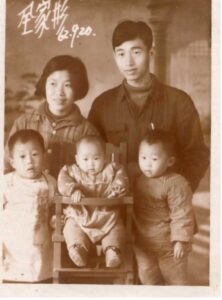
(Family Portrait, 1962)

Dad frequently made house calls to rural clinics and farmers' homes (as an obstetrics department head, Mom did the same). When an emergency demanded surgery, no matter the conditions, he would proceed. No electricity? Gather some flashlights, improvise, set up the operating table — saving the life came first. During the factional fighting of the Cultural Revolution in 1967, the two factions held their separate domains, with frequent clashes and occasional face-to-face combat. In the early days of street brawling, the weapons were still steel bars and cleavers; later they escalated to real firearms. The hospital was semi-paralyzed, located in territory controlled by the "Sweep Faction" — a radical mass organization calling itself the "Sweep the Black Line" group. Ideologically, Dad and Mom probably belonged to the moderate loyalist camp ("loyalist" meaning they opposed the purge of veteran cadres) and leaned toward the "Critique Faction" (the "Critique Alliance Group"), which had a loyalist tilt — though they took no part in its ideological or political activities. The Critique Faction's commander-in-chief had once been our neighbor, a strapping man. I remember that after assuming command, he wore a broad belt around his waist with a Mauser pistol holstered at his side — an image of martial splendor. It was this commander who quietly sent men to bring our entire family into the faction's headquarters; they urgently needed skilled medical hands to treat the wounded from the fighting. And so Dad set up a wartime surgical theatre — not unlike Dr. Norman Bethune's field hospital — and saved many lives.

In peacetime, the county hospital's white ambulance carried Dad, Mom, and our childhood to every corner of the county. When destinations were close, they would walk or bicycle to their patients. I remember when I was six or seven, our entire family moved to Hewan, a remote rural town, to support the village hospital for a year. Dad often bicycled out on night calls, sometimes taking me along. The sky was always so dark, and the route invariably passed through one or two cemeteries, the cold wind whistling overhead. Entering a village, we would hear dogs barking in waves. I would hide in Dad's arms on the front seat, often too frightened to open my eyes. After the treatment, beneath the dim glow of an oil lamp, the host would always cook two eggs in brown-sugar water and serve them steaming hot as a token of gratitude. Then, lighting the way with a flashlight, they would see us off — and I would be sound asleep long before we got home.

I was never very robust as a child, but at home I was sensible beyond my years — I would often volunteer to sweep the floor and wash the dishes. At school my grades were good, and I was the delight of my parents' hearts. At every major step of my life, from being sent down to the countryside to the oral examination for college entrance, from university registration to graduation and then graduate school interviews — until I was married and had a family of my own — Dad was always there, escorting and protecting me. Now that Dad had fallen ill, I was in a foreign land, unable even to bring him a cup of tea or water, unable to fulfill the most basic filial duties. Whenever I dwell on this, grief wells up from deep within.

But misfortune can turn into blessing. Dad's sudden illness led to early diagnosis and timely treatment, which was in his favor. What gives me comfort is that Dad received the best possible medical care, and most of the family was at his side looking after him. He recovered swiftly after the surgery, and the strength in his voice reassured everyone.

Dad is now semi-retired at home, still living modestly. He shows none of the signs of a man in his eighties — his life is orderly, his health robust, and he retains an eager curiosity for new things, handling a computer more adeptly than many young people. Beyond effortlessly consulting English-language medical literature, he has built up an English vocabulary over the years through extensive reading that rivals my own, even though I'm a "trained linguist." That his children have each found their own successful path is his greatest comfort. And the little stories of his grandchildren's growing up bring him abundant joy.


爸爸保重

朝华午拾 · 第六章

2007年我正在回访温哥华母校的路上,得知老爸突然大出血住院,行大手术。我远在天边,爱莫能助。无从床前伺候,共同面对风雨,深感愧疚。

父亲是我们全家的主心骨,大风大浪闯过来,人生很精彩。父亲操劳一辈子,一直退而不休,仗的就是身体好和心态好。

父亲比同龄人显得年轻很多。记得我上大学的时候,父亲不放心,一路送我到安庆。我们77级是文革后第一届大学生,社会上积压了近10年的高考大军,所以新生的岁数相差很大,包括一批被文革耽误的老三届高中生,比我年长10岁左右。父亲陪我到学校医务处做新生体检,护士指着我跟父亲说:一个一个来,等他检查完了,你再来。她把父亲当作新生了,可见父亲的年轻精神。

四年以后我毕业了,父亲还是不放心,来安庆接我,在学院住了一周,没事就跟我的"老下级"(我的下铺,因此总叫我"老上级")下象棋。老下级是老三届,49年生人,与新中国同岁。从旁观看,50年代就毕业的父亲真地象我们同学一样,仿佛我们中的一员。

有父亲照顾,我什么都不操心。父亲帮助把行李打包,我们与同学老师一一道别,就跟安庆说再见了,过江去赶长途公共汽车回家。轮渡误点了,一算时间非常紧张,一旦错过这班车,就不得不回安庆又耽搁一天。父亲二话不说,下了轮渡,把大小行李扛上,冲也似地往一两里外的汽车站赶,跟个小伙子一样。可怜我21岁正当年,空着手却气喘吁吁,被父亲远远抛在后面。

爸爸没有机会进入医学院,上的是医专,可他行医四十年所取得的成就,达到的高度,是常人难以企及的。靠的是,胆大心细,勤于实践,刻苦钻研。记得我们小时候,回家不见父母,总是到手术室去找。爸爸每天工作十多个小时,回家也是一头扎到医书里,很少见他休息。多年下来,名震四方,求医者络绎不绝。甚至上一级医院外科主任的亲属需要手术,也来找爸爸"这把刀"才觉得放心。

医生受人尊敬,但却是清贫的。在毛泽东时代,工资和物价均几十年不动。爸爸46元,妈妈43元,家庭收入89元一月,维持一家六口(加上外祖母)温饱,难有积余。生活苦点,倒也无所谓。其实我们从来也没有觉得苦,尽管每餐饭,一大家人才有一两碟小菜。反正大家都苦,还有很多人吃不饱饭,只能喝粥、吃红薯干呢。爸爸的难题是,到哪里去攒买书的钱呢?那些大厚本的专业书籍《外科学》、《骨科学》等,定价不菲,却是工作必不可少的。谁能想到,许多医书是爸爸瞒着家人卖血换来的。一次300cc血浆,当时的价格30元,这可是平时半年也难攒下的钱啊。有一次,妈妈发现以后非常生气。爸爸很清瘦,担心他卖血损害了身体。可爸爸总是说,人有造血机制,失点血无碍。不过,除此之外,还有别的办法么?医术再精湛,也变不了钱。记得手术误餐,当时的补贴也才两角,或者供应一碗免费肉丝面(爸爸妈妈舍不得吃,常常带回家给我们孩子吃)。

一个时代,一种活法。可是,一个享有盛誉、对医术精益求精的医生非卖血不能拥有医书,这样的事古今中外,大概也只有毛时代了。不能说,爸爸没有赶上好时代,从事业的追求和精神的满足看,那个特定的时代特定的条件,给爸爸一个难得的施展空间。基层县医院象一张白纸,面对的是源源不断的一向缺医少药、经济能力匮乏的农村患者。多数这样的患者基层医院不能救治,也就只好自生自灭,听天由命了。爸爸是医院的开创者之一,有充分自主权,有多大精力就有多少工作,几十年来几乎每天都有几台手术。我当年认识一位农村青年医生,由于不能施展,而厌倦行医,转报英文师专,当谈起爸爸的医术,却充满钦佩:"你知道么?你爸爸是世界上最了不起的医生。许多省立大医院尚未开展或普及的大手术,你爸爸也能做。"他给我讲解一些案例,我也不懂,但是心里明白,爸爸一直在超越自己,向越来越复杂的手术攀登。后来,跟爸爸谈起来,还有哪些疑难手术,想做而做不成。爸爸说,能做的差不多都做了,但是有些手术,比如显微外科,断肢再植等,对于器械要求太高,县医院没有这种条件,只好遗憾了。

跟"有理无钱莫进来"的衙门不同,当年在基层医院贫苦农民也能开得起刀:印象中小手术(阑尾摘除等)收费不到10元,中等手术(胃切除等)收费几十元,大手术(心脏、脑等)也不过百元。当然,凑足这钱也不容易,但是为看病节衣缩食,或砸锅卖铁,多数人还是想出了办法。对于特困户,可以到民政局申请补助。改开前时代的这一点,还是值得称颂的。收费低廉的根本原因,当然是成本底:医生是国家干部,拿固定工资,没有额外支出。

说到手术,我的身上也留有爸爸的"杰作"。我十岁左右,有一天早饭不久,突然肚子疼得厉害。爸爸过来检查,按住右小腹,问疼不疼,我说,"很疼"。他突然把手抽回,我一阵剧痛,眼泪都出来了。爸爸告诉我,这叫"反跳痛",是急性阑尾炎的典型症状,说准备开刀,不到中午就扶我进了手术室。从小看惯了开刀,知道阑尾摘除是小手术,我一点也不怕。可真要上手术台了,我却怎么也不愿意。主要是怀疑弄错了,白挨刀了。早上还是好好的,喝了半碗粥,我平时也常闹肚子疼,这次,也没有验血或做其他检查,摸摸小腹,就这样确诊了?结果自然是我多虑,割下的阑尾肿得象棵小胡萝卜头,因为手术及时,还没有化脓。不少外科大夫不给自己亲人开刀,怕太紧张。可爸爸不放心别人,理所当然亲自动手,妈妈在旁做助手。本来,如果使用常规腰麻或硬膜外麻醉,也可从容不迫,但爸爸为了术后反应小,坚持只使用局部麻醉,我能清楚知道手术的每一个过程。多数同类手术刀口总有几寸,可爸爸只给我开了一条一两公分的小口子(关腹后只缝了两针),刚够伸进一个手指。这还不算,跟多数刀口不同,爸爸用的是横切,这更增添了手术难度。爸爸说,横切符合人的腹部的自然纹路,愈合后刀疤不显(确实如此,我见过其他竖切手术的刀痕,愈合后很久仍然粗粗红红地立在那儿,很难看)。这次手术很成功,我当天回家,第二天就可下床轻微走动。不过,手术中有一阵确实很疼,我大哭大叫,给爸爸增加了很大压力。那是爸爸伸进手指试图捞取发炎的阑尾时。也不怪,阑尾发炎,不碰它尚且疼痛得很呢。好在疼得时间不长,爸爸就逮住了它,赶紧补上一针麻醉。后来,爸爸说,尽管费了心思,下刀之处还是略偏了点,使我多受了一些苦。偏一点没关系,如果把刀口加大点,也好办,可爸爸坚持尽可能小的口子,不愿意让我落下一个永久的大疤痕。我把这个故事讲给女儿听,她找到我的几乎看不见了的刀口,惊叹:"Grandpa did a terrific job!"。从此,她肚子一疼,就大叫,怀疑得了阑尾炎,非让我检查发现没有"反跳痛"才安心。还说,她要是得了阑尾炎,就飞回去找爷爷,可信不过美国的大夫:他们才开过几个刀,我爷爷一辈子开刀何止成千上万!

爸爸常常出诊到农村医院和农民家中(作为妇产科主任,妈妈也一样)。遇到急诊需要手术,不管什么条件,也要进行。没有电,就集中一些手电筒,因陋就简,搭起手术台,救命要紧。文革武斗那年(1967年),两派割据,常有摩擦,亦有短兵相接的时候:初期街头械斗,用的还是钢钎菜刀之类,后期可用上了真枪真炮。医院处于半瘫痪状态,并且地处"扫派"(叫"扫黑线",一激进派群众组织)掌控辖区。爸爸妈妈思想上大概属于温和保皇派("保皇"即反对揪斗老干部),倾向有保皇色彩的"批派"(叫"批联部"),但并不参与其意识形态和政治生活。批派的总司令曾是我家的邻居叔叔,身材魁伟。印象中担任司令以后,他腰扎宽皮带,挎盒子枪,好不英武威风。是总司令派人悄悄把我们全家请到这一派的大本营里,他们急需医疗好手救治武斗中的伤员。于是爸爸搭起战时手术台,就跟白求恩的战地医院似的,也救了不少人的命。

和平岁月,县医院那辆白色救护车,载着爸爸妈妈和我们的童年跑遍了全县每一个角落。如果路近,也步行或骑自行车出诊。记得我六七岁的时候,全家去偏远乡镇河湾,支援农村医院一年。爸爸晚上经常骑车出诊,有时也带着我。天总是那样黑,也总要经过一两个墓地,头顶冷风飕飕。进入村子,总有此起彼伏的狗吠声。我躲在车前座爸爸怀中,常常不敢睁开眼睛。看完病,在昏黄的油灯下,主人总要用红糖水煮两个鸡蛋,热气腾腾端上来,款待我们。然后,照着手电,送我们上路,而我不等到家,就已经睡熟了。

我从小身体不大好,小时候在家很懂事的样子,常主动要求扫地洗碗,在学校成绩也好,很讨爸爸妈妈的欢心和疼爱。直到结婚成家前,我生活的每一大步,从下乡插队到高考口试,从大学报到到毕业离校再到研究生面试,都有父亲陪同呵护。如今父亲病倒了,我却远在异国他乡,不能端茶递水,略尽孝道。每念及此,不由得悲从中来。

坏事变好事,父亲这次急病倒下,对病情的早期诊断和及时治疗有利。得以宽心的是,父亲得到了最好的医疗条件,家人也多在身边照顾。父亲术后恢复很快,说话很有底气,全家人都松了口气。

爸爸现在半退休在家,依旧清贫。一点不象80多岁的老人,生活有条不紊,身体健康,仍保持对新事物的好学之心,电脑玩得比许多年轻人还熟。除了熟练查阅英文专业资料外,长年博文强识,普通词汇量跟我这英语"科班"出身的也有一比。子女各自发展,是他最大的安慰。孙儿辈的成长花絮,更给他带来欢乐。


From 朝华午拾. Original Chinese: 爸爸保重.